Ecode Dash Blog
Integrating DevSecOps and QA Automation: How to Scale Secure Product Engineering
Discover how integrating DevSecOps specialists, penetration testers, and QA automation engineers bridges the gap between rapid delivery and enterprise-grade resilience across modern engineering teams.
By Ecode Dash Editorial Team · Software Engineering & Technology Consulting
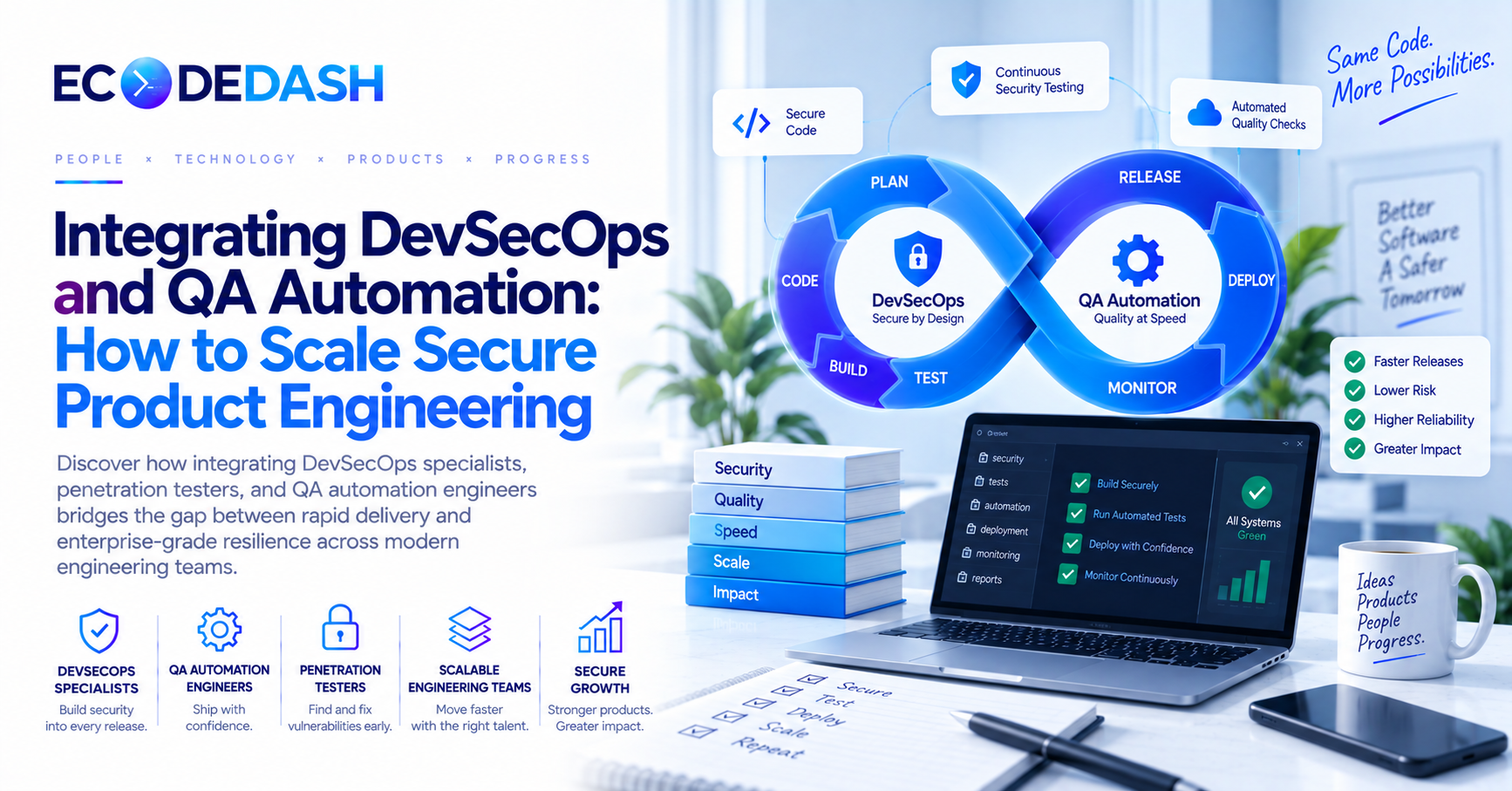
In modern software delivery, speed without rigorous quality assurance and continuous security creates catastrophic technical debt. Engineering leaders frequently find that accelerating release velocity leads to regressions, unpatched vulnerabilities, and bloated QA cycles right before launch. To maintain rapid development while preserving infrastructure resilience, modern tech organizations are moving away from siloed testing and embracing embedded DevSecOps practices.
Achieving this balance requires embedding specialized talent—including DevSecOps engineers, penetration testers, and QA automation specialists—directly into the continuous integration and continuous deployment (CI/CD) pipeline. Whether building distributed cloud architectures or cross-platform mobile apps, integrating automated verification and automated security controls from day one is essential to sustainable scaling.
The Realities and Challenges of Scaling an Engineering Team
When scaling technical capacity, engineering leaders encounter compounding hurdles. The operational challenges of scaling an engineering team rarely stem from a simple shortage of general coders; rather, they arise from friction in quality gating, testing throughput, and security oversight.
Key bottlenecks during aggressive expansion include:
- Linear QA Bottlenecks: Manual testing processes fail to keep up when feature throughput doubles or triples, causing sprint releases to stall.
- Late-Stage Security Discoveries: Treating penetration testing as a periodic checklist item before major milestones forces costly code refactoring when critical flaws emerge late.
- Skill Gaps in Modern Tooling: Building automated Static Application Security Testing (SAST), Dynamic Application Security Testing (DAST), and Software Composition Analysis (SCA) requires niche DevSecOps expertise that generalist developers rarely possess.
- Cross-Platform Fragmentation: As products scale across web, iOS, and Android ecosystems, testing complexity multiplies across varied device form factors, operating systems, and API versions.
To overcome these hurdles, forward-thinking CTOs combine core architecture teams with elastic staffing models to inject deep domain expertise without stalling roadmap execution.
Unpacking the Delivery Models: Dedicated Teams vs. Staff Augmentation
When expanding engineering bandwidth, organizations generally evaluate two primary engagement frameworks: building an extended team or leveraging specialized augmentation.
| Attribute | Dedicated Team in Software Development | IT Staff Augmentation Services |
|---|---|---|
| Operational Ownership | End-to-end management of features and milestones | Client manages day-to-day workflow and tasks |
| Best For | Greenfield projects, autonomous modules, total sub-systems | Injecting specific skills (DevSecOps, QA automation, mobile) |
| Integration Speed | Fast ramp-up for structured squad delivery | Rapid onboarding (often within 48 to 72 hours) |
| Governance & Reporting | Managed via squad leads, sprint deliverables, and SLAs | Embedded directly into internal standups and Jira boards |
The Dedicated Team Model
Deploying a dedicated team in software development gives companies an autonomous, cross-functional unit—typically pairing full-stack developers, mobile specialists, QA automation leads, and DevSecOps practitioners under unified product direction. By outsourcing software development to dedicated team structures, enterprises can offload entire functional components (such as a customer-facing mobile application or an internal data pipeline) while internal staff focus on core intellectual property.
Partnering with a seasoned dedicated team of software development professionals ensures consistent engineering culture, battle-tested Git branching strategies, and continuous automated verification embedded directly into sprints.
IT Staff Augmentation: Definition and Mechanics
For organizations that already maintain structured in-house engineering governance, evaluating a can it staff augmentation services definition reveals a distinct advantage: pinpoint capacity expansion. In this model, pre-vetted engineers join existing scrums under direct internal technical leadership.
When drafting a can it staff augmentation services proposal or building an internal can it staff augmentation services presentation for executive leadership, CTOs highlight key contractual terms:
- Clear IP Assignment: Comprehensive clauses ensuring complete ownership of code repositories, test suites, and infrastructure pipelines.
- SLA & Availability Metrics: Establishing exact time-zone overlaps and sprint participation standards.
- Flexible Scale Clauses: Understanding how a can it staff augmentation services contract allows agile scaling up or down based on release milestones.
By leveraging flexible engineering extension teams, engineering organizations can integrate specialized QA automation and DevSecOps talent without taking months to hire locally.
Integrating DevSecOps and Penetration Testing into the Pipeline
Securing applications cannot remain an afterthought handled in bi-annual audits. Modern threat vectors necessitate continuous security embedded directly into the developer workflow.
1. Shift-Left Security with SAST, DAST, and SCA
DevSecOps specialists structure CI/CD pipelines to inspect code at commit time, build time, and deployment:
- Pre-Commit / Static Analysis (SAST): Scans pull requests automatically for known anti-patterns, hardcoded credentials, and memory leaks before merging into the release branch.
- Software Composition Analysis (SCA): Catalogs every open-source dependency, flagging unpatched Common Vulnerabilities and Exposures (CVEs) and license compliance issues.
- Dynamic Application Security Testing (DAST): Executes automated black-box probing against staging environments to detect runtime flaws such as SQL injection, Cross-Site Scripting (XSS), and insecure API endpoints.
2. Routine Penetration Testing in Sprint Cycles
While automated tooling catches programmatic vulnerabilities, experienced penetration testers simulate active, creative adversarial tactics. By incorporating red-team assessments during feature rollouts, penetration testers uncover complex logic bypasses, broken object-level authorization (BOLA) in REST and GraphQL APIs, and misconfigured cloud IAM policies that automated scanners miss.
3. Automated QA Frameworks: Bridging Unit, Integration, and E2E Tests
QA automation engineers complement DevSecOps by building deterministic, self-healing test automation suites:
- API Contract Testing: Utilizing tools like Pact or Postman CLI to ensure microservices maintain strict API schema parity.
- UI and Cross-Platform Automation: Implementing frameworks like Cypress, Playwright, or Appium to simulate user journeys across multiple environments.
- Performance and Load Testing: Running automated k6 or JMeter routines in pre-production to identify concurrency bottlenecks prior to launch.
Special Considerations for Mobile Engineering: React Native Workflows
Cross-platform mobile applications present unique security and quality challenges. Because mobile client binaries run on untrusted end-user devices, mobile security requires strict binary hardening, obfuscation, API token protection, and certificate pinning.
How to Hire React Native Developers with Security Acumen
Engineering managers wondering how to hire react native developers who understand enterprise-grade mobile security must look beyond basic JavaScript/TypeScript and UI component building. Key competencies to assess include:
- Deep understanding of the React Native bridge and TurboModules architecture.
- Hands-on experience implementing biometric authentication (FaceID/TouchID) and Encrypted Storage / Keychain integrations.
- Mastery of mobile-specific CI/CD pipelines (Fastlane, Bitrise, GitHub Actions) and automated end-to-end testing with Detox or Appium.
Leveraging Global Talent Hubs for Mobile Engineering
Many tech companies actively choose to hire react native app developers india or engage dedicated mobile pods to accelerate cross-platform product lifecycles. When companies decide to hire react native app developers in india, they gain access to senior engineers with extensive experience across large-scale fintech, healthtech, and consumer applications. Sourcing pre-vetted mobile talent through premier it staff augmentation services in india allows enterprises to cut development cycles while maintaining strict code quality and automated testing baselines.
Global Staffing Landscapes: Choosing the Right Region
Depending on budget, timezone constraints, and compliance mandates (such as HIPAA, GDPR, or SOC 2), engineering leaders evaluate talent across different geographic hubs.
North American Augmentation: US and Canada
For enterprises requiring same-timezone collaboration, high-compliance clearance, or immediate on-site integration, leveraging it staff augmentation services usa remains a preferred path. US-based staff augmentation provides instant alignment with federal and industry-specific governance requirements.
Similarly, organizations exploring it staff augmentation services in canada benefit from a deep pool of cloud and enterprise software talent, favorable economic cost structures, and shared North American time zones. Combining Canadian and US engineering capacity enables seamless nearshore collaboration for high-touch Agile projects.
Offshore Expansion: India and APAC
For high-velocity scaling, round-the-clock development cycles, and deep benches in emerging stacks (such as AI/ML, Kubernetes, and mobile), partnering with the top it staff augmentation services operating across India and APAC delivers unmatched scalability. When integrated under clear coding guidelines and automated CI/CD guardrails, distributed global pods keep product development moving 24/7.
Tactical Blueprint: Integrating DevSecOps and QA into Your Sprints
To move from fragmented testing to unified automated product verification, engineering organizations should follow this progressive implementation roadmap:
+-------------------------------------------------------------------------+
|                        Continuous Delivery Pipeline                     |
+-------------------------------------------------------------------------+
|  1. Code Commit  -->  SAST & Dependency Scanners (SCA)                  |
|  2. Build Stage  -->  Automated Unit & Integration Tests                |
|  3. Staging Env  -->  DAST Scans + End-to-End E2E (Playwright/Detox)    |
|  4. Pre-Release  -->  Automated Load Tests + Pentest Review             |
|  5. Production   -->  Continuous Observability, RASP, & Drift Detection |
+-------------------------------------------------------------------------+
Step 1: Establish Automated Quality Gates in Pull Requests
Set strict branch protection rules in GitHub or GitLab. No pull request should merge into the release branch without passing:
- 100% of unit test suites.
- Static analysis security scans with zero critical or high severity CVEs.
- Linter and type-checking validations.
Step 2: Decouple Test Execution with Ephemeral Staging Environments
Utilize containerized test environments (using Docker and Kubernetes) created dynamically for every major feature branch. QA automation engineers run end-to-end integration suites against real database seeds, discarding the environment once tests finish.
Step 3: Schedule Continuous Red-Team and Pentest Audits
Embed penetration testers directly into quarterly release planning. Rather than treating penetration testing as a blocker at the end of the year, run targeted penetration tests against new API endpoints, authentication flows, and microservice mesh configurations as they are built.
Step 4: Monitor and Refine with Lead Time and Defect Metrics
Track four critical engineering metrics to measure the ROI of integrated DevSecOps and QA automation:
- Change Failure Rate (CFR): Percentage of deployments causing production degradation.
- Lead Time for Changes: Time elapsed between code commit and production deployment.
- Mean Time to Recovery (MTTR): Speed of resolving production incidents or security alerts.
- Defect Escape Rate: Volume of bugs discovered by end-users in production versus caught in CI/CD.
Accelerating Your Engineering Capabilities with Ecode Dash
Building resilient, secure, and high-performance digital products requires the right talent deployed at the right time. Whether you need to embed DevSecOps specialists to automate your deployment pipelines, penetration testers to audit cloud architectures, senior QA automation engineers to build reliable test frameworks, or expert mobile developers to scale your React Native roadmap, having an agile talent partner is critical.
Ecode Dash delivers pre-vetted, top 5% senior engineering talent across 50+ technology stacks—deployable within 48 hours. Ready to bridge your technical bandwidth gap, eliminate QA bottlenecks, and harden your product pipeline? Scale your engineering organization with vetted tech talent and build with complete confidence.