Ecode Dash Blog
Navigating Domain Complexity and Regulatory Compliance in FinTech, HealthTech, and SaaS with Specialized Engineering Squads
Discover how enterprise FinTech, HealthTech, and SaaS companies navigate rigorous compliance frameworks and architectural bottlenecks using specialized IT staff augmentation and dedicated engineering squads.
By Ecode Dash Editorial Team · Software Engineering & Technology Consulting
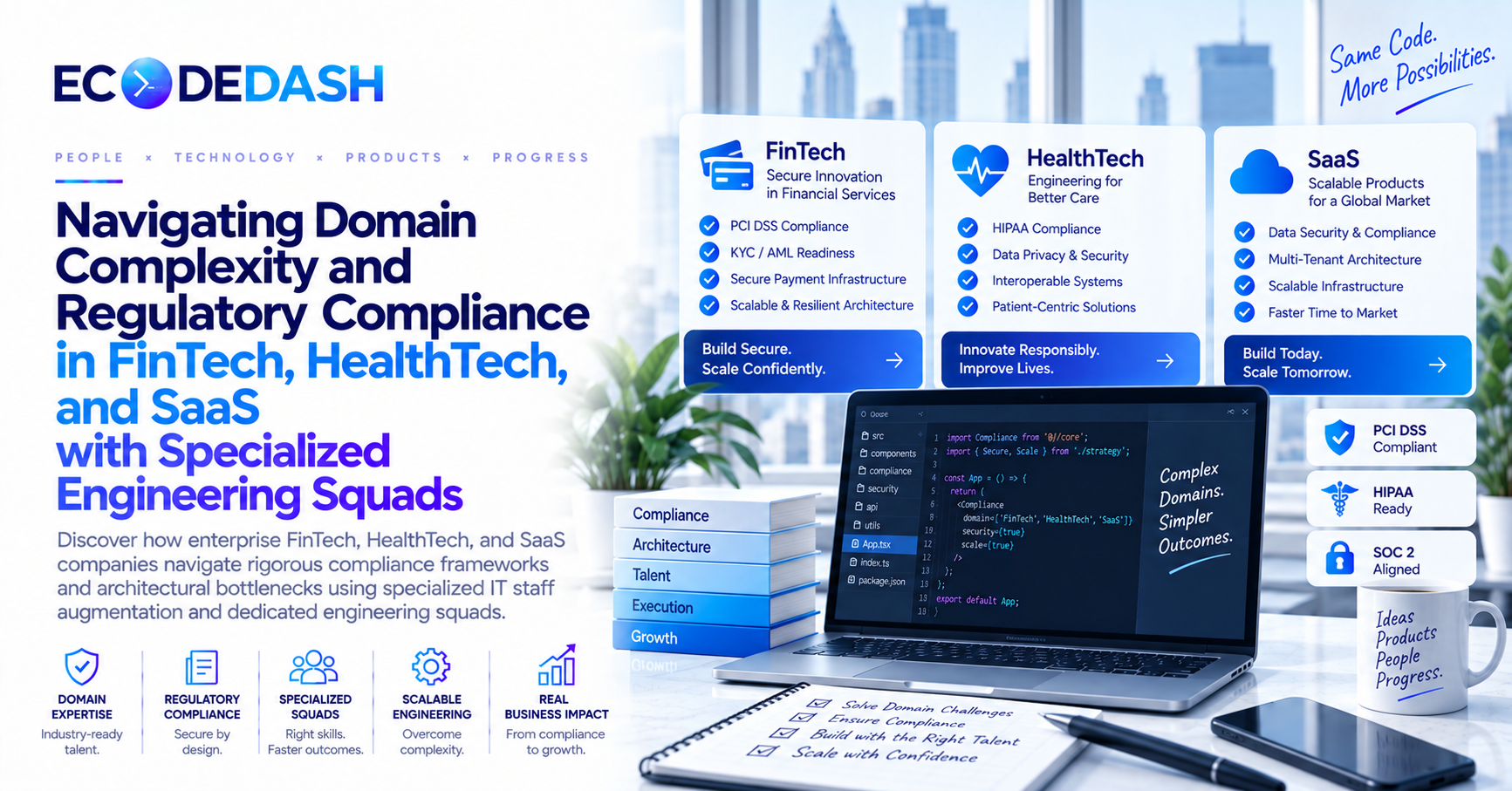
Scaling digital products in highly regulated industries is rarely a linear engineering challenge. In FinTech, HealthTech, and mission-critical enterprise SaaS, technical leaders are not merely writing performant code—they are building systems that must continuously satisfy strict regulatory oversight, data sovereignty mandates, and zero-trust security postures.
A single architectural misstep in an electronic health record (EHR) integration or an automated clearinghouse (ACH) payment pipeline can lead to severe regulatory fines, reputational destruction, and immediate customer churn. Consequently, the traditional playbook of generic hiring or low-cost transactional outsourcing frequently collapses under the weight of specialized domain requirements.
To maintain development velocity without compromising governance, engineering leaders increasingly turn to specialized engineering squads and modern staffing models. This strategic framework explores how organizations successfully navigate domain complexity, evaluate flexible talent models, and structure high-performing engineering squads across regulated verticals.

The Core Definition: Deconstructing Staff Augmentation vs. Dedicated Squads
Before structuring an external partnership, technical executives must establish absolute clarity regarding engagement models and governance terminology.
+-----------------------------------------------------------------------------+
|                        ENGINEERING ENGAGEMENT SPECTRUM                     |
+-----------------------------------+-----------------------------------------+
|      Staff Augmentation           |        Dedicated Engineering Squads      |
+-----------------------------------+-----------------------------------------+
| • Individual contributor capacity | • Autonomous, cross-functional units    |
| • Managed directly by internal EM | • Embedded domain context & QA/DevSecOps|
| • Fast ramp for skill gaps (48h)  | • End-to-end milestone accountability    |
| • Flexible hourly/retainer terms  | • Long-term architectural ownership     |
+-----------------------------------------------------------------------------+
Can IT Staff Augmentation Services Definition Solve the Velocity Trap?
When leaders ask for the practical definition of IT staff augmentation services, they are looking at an operational model where pre-vetted external engineers integrate directly into an in-house engineering structure under existing engineering managers. Unlike legacy vendor models where deliverables are isolated, augmented engineers adopt your CI/CD pipelines, participate in daily standups, and write directly to your code repositories.
Conversely, outsourcing software development to dedicated team models involves spinning up complete, cross-functional squads—including frontend developers, backend specialists, QA automation leads, and DevSecOps engineers—who take ownership of discrete architectural sub-domains. In regulated environments, hybrid models frequently yield the best balance: dedicated squads manage discrete, compliance-heavy services, while augmented staff fill niche technical gaps.
The Structural Challenges of Scaling an Engineering Team in Regulated Sectors
Scaling an engineering organization in a standard consumer app environment primarily revolves around speed, feature experimentation, and UI iteration. In enterprise SaaS, FinTech, and HealthTech, engineering leadership faces unique compounding bottlenecks.
1. Complex Regulatory Overlays and Compliance Velocity
Software architectures must adhere to dynamic compliance frameworks depending on geography and vertical:
- FinTech: PCI-DSS Level 1, SOC 1/2 Type II, GLBA, ISO/IEC 27001, and regional anti-money laundering (AML) / Know Your Customer (KYC) requirements.
- HealthTech: HIPAA, HITECH, FDA Software as a Medical Device (SaMD) guidelines, GDPR Health Data clauses, and FHIR/HL7 interoperability standards.
- Enterprise SaaS: SOC 2 Type II, ISO 27701, FedRAMP, and cross-border data residency mandates.
When scaling internal teams rapidly, onboarding developers who lack foundational security hygiene introduces systemic risk. Generalist engineers might inadvertently log Personally Identifiable Information (PII) or unmasked Protected Health Information (PHI) to non-compliant monitoring tools like standard Sentry or Datadog clusters.
2. The Talent Scarcity for Deeply Specialized Stacks
Finding engineers who possess both high-level framework mastery and deep domain knowledge is notoriously difficult in domestic markets. A team building an offline-first clinical trial mobile application or a high-frequency trading ledger cannot afford months of trial-and-error onboarding.
3. Context Dilution and Knowledge Fragmentation
As teams balloon from 20 to 100+ engineers, documentation bottlenecks and fragmented architectural context slow sprint completion rates. Without structured onboarding protocols, new hires take up to six months to become net-positive contributors.
Global Talent Corridors: Strategic Staffing Across India and Canada
To balance unit economics with elite technical competence, enterprise organizations rely on mature global engineering hubs.
Leveraging IT Staff Augmentation Services in India
India has evolved from a transactional outsourcing hub into a global epicenter for deep-tech, cloud-native architecture, and AI/ML engineering. With over 5 million software professionals, utilizing IT staff augmentation services in India allows North American and European enterprises to:
- Access Tier-1 Seniority: Deploy the top 5% of engineers who have direct experience architecting microservices for global banking institutions and tier-1 SaaS unicorns.
- Run 24/7 Follow-the-Sun Engineering: Enable continuous integration, automated testing cycles, and real-time DevSecOps remediation during overnight domestic hours.
- Cost Efficiency at Scale: Reallocate engineering budgets toward strategic R&D while scaling production capacity rapidly.
Nearshore & Co-Location: IT Staff Augmentation Services in Canada
For organizations requiring complete working-hour synchronization, strict North American data residency collaboration, or specific bilateral IP protections, IT staff augmentation services in Canada represent an ideal nearshore alternative. Canadian tech hubs (Toronto, Vancouver, Waterloo, Montreal) offer world-class engineering caliber, seamless cultural alignment, and shared time zones with US tech headquarters.
Specialized Focus: Mobile Architecture & How to Hire React Native Developers in Regulated Spaces
Cross-platform mobile development using React Native has become the standard for modern FinTech and HealthTech applications. It eliminates codebase duplication across iOS and Android while offering near-native execution performance. However, building compliant cross-platform applications requires rigorous engineering standards.
+-----------------------------------------------------------------------------+
|              SECURE REACT NATIVE ARCHITECTURE IN REGULATED DOMAINS           |
+-----------------------------------------------------------------------------+
|  [ Presentation Layer ]  --> Obfuscated UI / Biometric Auth (FaceID/Finger) |
|           |                                                                 |
|  [ Bridge / JSI Layer ]  --> Zero Plaintext PHI/PII in Async Storage        |
|           |                                                                 |
|  [ Storage Layer ]       --> Hardware KeyStore / iOS Keychain Encryption    |
|           |                                                                 |
|  [ Network Layer ]       --> Dynamic SSL Pinning + Certificate Transparency|
+-----------------------------------------------------------------------------+
Key Competencies When You Hire React Native App Developers in India
When evaluating candidates or specialized partners to hire React Native app developers in India, engineering directors should assess candidates on specific security and architectural proficiencies:
- Hardware-Level Secure Storage: Expertise implementing Keychain on iOS and EncryptedSharedPreferences / KeyStore on Android, avoiding unencrypted `AsyncStorage` for sensitive session tokens or encryption keys.
- Network Security & Certificate Pinning: Practical implementation of TrustKit or custom OkHttp client interceptors to prevent Man-in-the-Middle (MitM) attacks.
- App Hardening & Reverse Engineering Defense: Knowledge of DexGuard/ProGuard configurations, jailbreak/root detection scripts, and dynamic binary analysis protection.
- Regulatory Compliance in Client-Side State: Ensuring caching layers (Redux, Zustand, React Query) sanitize and purge in-memory cache upon session timeout or app backgrounding.
A Step-by-Step Vetting Framework: How to Hire React Native Developers
To reliably source and onboard top-tier engineers without getting bogged down by unqualified resumes:
- Phase 1: Deep Architectural Screening: Present real-world scenario tests covering Bridge/JSI performance optimization, memory leak mitigation, and custom Native Module bridges.
- Phase 2: Security & Threat Modeling Assessment: Have candidates identify vulnerabilities in a sample banking/telehealth pull request containing insecure caching and weak cryptographic implementations.
- Phase 3: Live Pair Programming: Evaluate communication clarity, system design reasoning, and clean-code practices under production constraints.

Structuring the Partnership: Contracts, Proposals, and Presentations
Establishing an external engineering engagement requires rigorous procurement and legal due diligence. Technical leaders, legal counsel, and procurement officers must align on clear governance artifacts.
+-----------------------------------------------------------------------------+
|                 GOVERNANCE & PROCUREMENT ARTIFACT CHECKLIST                 |
+-----------------------------------------------------------------------------+
| 1. IT Staff Augmentation Services Proposal                                  |
|    • Skill matrices, SLA benchmarks, replacement guarantees, rate card     |
| 2. IT Staff Augmentation Services Contract (MSA + SOW)                      |
|    • Full IP assignment, DPA (GDPR/HIPAA), strict non-solicitation, SLAs   |
| 3. Executive / Stakeholder Presentation                                     |
|    • Cost-benefit analysis, velocity metrics, ramp-up schedules            |
+-----------------------------------------------------------------------------+
1. What Belongs in an IT Staff Augmentation Services Proposal?
An enterprise-grade IT staff augmentation services proposal should contain far more than pricing tables. It must detail:
- Talent Curation & Screening Methodology: Transparent breakdown of the vetting funnel (e.g., top 5% acceptance rate).
- Deployment SLAs: Guaranteed timeframes for candidate profile presentation (typically 48 hours for pre-vetted talent) and replacement protocols.
- Security & Environment Alignment: Details on developer workstation provisioning, VPN access control, SOC 2 compliance of the provider, and MDM (Mobile Device Management) policies.
- Ramp-Up Roadmap: Day 1 to Day 30 milestones covering repository onboarding, tooling access, and code contribution targets.
2. Drafting an Airtight IT Staff Augmentation Services Contract
When executing a legal agreement for IT staff augmentation services contracts, enterprise counsel must prioritize:
- Comprehensive IP Assignment: Immediate, worldwide assignment of all inventions, source code, scripts, and documentation created during the engagement.
- Data Protection Agreements (DPA): Standard Contractual Clauses (SCCs) for cross-border data transfer, HIPAA Business Associate Agreement (BAA) provisions where applicable, and mandatory breach notification within 24–48 hours.
- No-Fault Engineer Replacement Clause: The ability to swap out any engineer who fails to meet technical or cultural expectations within an initial trial period without incurring double-billing.
- Right to Audit: Explicit authorization for the client's compliance officers to audit the vendor's security controls, background check procedures, and physical/virtual security environments.
3. Delivering the Executive IT Staff Augmentation Services Presentation
When building a business case for an IT staff augmentation services presentation to the CTO, CFO, or Board of Directors, focus on tangible financial and operational metrics:
- Time-to-Productivity Comparison: Show how a 48-hour matching cycle beats the average 90-day domestic hiring cycle.
- Cost-per-Deliverable Economics: Contrast full-time employee (FTE) loaded costs (recruiting fees, benefits, payroll tax, hardware, equity) against variable-capacity augmentation.
- Risk Mitigation Strategy: Highlight how dedicated engineering extension squads isolate domain risks through specialized QA automation and regulatory-hardened development practices.
Comparison: Staff Augmentation vs. Dedicated Team Software Development
To help technology leaders choose the right operational vehicle, the table below compares core engagement attributes across typical engineering scenarios:
| Operational Dimension | Staff Augmentation | Dedicated Team Software Development | Traditional Fixed-Price Project |
|---|---|---|---|
| Management Control | Client EM retains direct day-to-day oversight | Shared oversight via dedicated Tech Lead | Vendor PM controls delivery |
| Domain Ramp-up | Immediate; individual adapts to existing team | Rapid; team incorporates standardized domain protocols | Slow; extensive scoping required |
| Compliance Alignment | Developer follows client's internal compliance directly | Squad follows tailored SOC2/HIPAA SOPs | Black-box risk; compliance verified at end |
| Best Used For | Core stack scaling, niche skill gaps (e.g., React Native) | Building discrete sub-services, new microservices | Well-defined, non-core legacy migrations |
| Deployment Speed | Under 48 hours with pre-vetted networks | 1–3 weeks for full team assembly | 4–8 weeks of RFPs and scoping |
| Flexibility | Monthly elastic scale-up / scale-down | Quarterly roadmap scaling | Low; change orders required for every pivot |
Operational Blueprint: Integrating Dedicated Squads Without Breaking Governance
Deploying external engineers into sensitive architectures requires an uncompromising Zero-Trust onboarding framework. Follow these operational steps to safeguard your engineering pipeline:
Step 1: Ephemeral Access Provisioning (Least Privilege RBAC)
        |
Step 2: Automated Pre-Commit Security Hooks (Secret Scanning & SAST)
        |
Step 3: Isolated Staging Environments with Synthetic Data (No Live PII/PHI)
        |
Step 4: Continuous Peer Review & Mandatory Branch Protection Rules
Step 1: Enforce Role-Based Access Control (RBAC) & Principle of Least Privilege
Never issue universal repository access to new engineers on Day 1. Provision scoped IAM roles, ephemeral access tokens, and segment codebases using microservices architecture so external developers only interact with their designated services.
Step 2: Implement Automated DevSecOps Pre-Commit Hooks
Integrate automated linting, static application security testing (SAST), and secret scanning (e.g., GitGuardian, Trivy, SonarQube) directly into the CI/CD pipeline. Any pull request containing hardcoded credentials, unmasked logging statements, or vulnerable dependencies should be automatically rejected before human review.
Step 3: Mandate Synthetic Test Data in Non-Production Environments
Under no circumstances should external augmented staff work with live customer PII or PHI. Deploy synthetic data generation scripts (e.g., Faker, custom seeders) to replicate complex production edge cases in staging environments without exposing regulated user records.
Step 4: Strict Branch Protection and Dual-Approval Code Reviews
Configure repository branch protection rules requiring at least two senior internal code reviews and 100% green status on automated test suites before any pull request can be merged into `main` or `staging` branches.
Real-World Case Examples: Navigating Niche Domain Engineering
FinTech: PCI-DSS Compliant Payment Gateway Refactoring
A Series-B fintech platform processing over $50M in monthly recurring billing needed to decouple its legacy monolithic checkout service into an isolated, PCI-DSS Level 1 compliant tokenization vault.
By deploying an augmented squad of senior Go and React Native engineers through expert IT staff augmentation services, the company achieved complete architectural isolation within 12 weeks. The client maintained full oversight of the cryptographic key management module while the augmented squad built the surrounding API wrappers and automated regression test suites, passing their external PCI audit on the first pass.
HealthTech: HIPAA-Compliant Telehealth Mobile Redesign
A healthcare provider needed to transition its patient portal from a sluggish legacy web wrapper into a responsive, high-security React Native mobile app.
The engineering leadership brought in specialized React Native app developers from an AI-curated talent network. The team implemented hardware-backed biometric authentication, dynamic certificate pinning, and end-to-end encrypted WebRTC video streaming. The resulting app achieved 99.98% crash-free sessions while fully adhering to HIPAA patient privacy and audit-logging rules.
Scaling Engineering Capacity with Confidence
Building software in regulated, high-stakes environments does not require you to choose between development speed and absolute compliance. By transitioning away from transactional staffing and embracing structured, pre-vetted engineering augmentation, engineering leaders can solve the most acute scaling bottlenecks while maintaining strict governance.
Whether you need to instantly scale capacity with pre-vetted senior developers across India or Canada, or assemble a specialized squad to build high-performance, secure React Native applications, partnering with an agile talent curation platform ensures your team hits delivery milestones without architectural compromise.
Scale Your Engineering Capacity Within 48 Hours
Stop letting long hiring cycles and domain complexity delay your product roadmap. Explore our expert IT staff augmentation and engineering extension services to deploy top 5% pre-vetted engineers, AI/ML specialists, and mobile developers tailored to your exact regulatory and technology requirements.