Ecode Dash Blog
Scaling Engineering Velocity: Why Extension Teams Beat Traditional Agency Overhead
Discover how engineering extension teams and modern IT staff augmentation allow scale-ups and enterprises to scale software development velocity without traditional agency overhead.
By Ecode Dash Editorial Team · Software Engineering & Technology Consulting
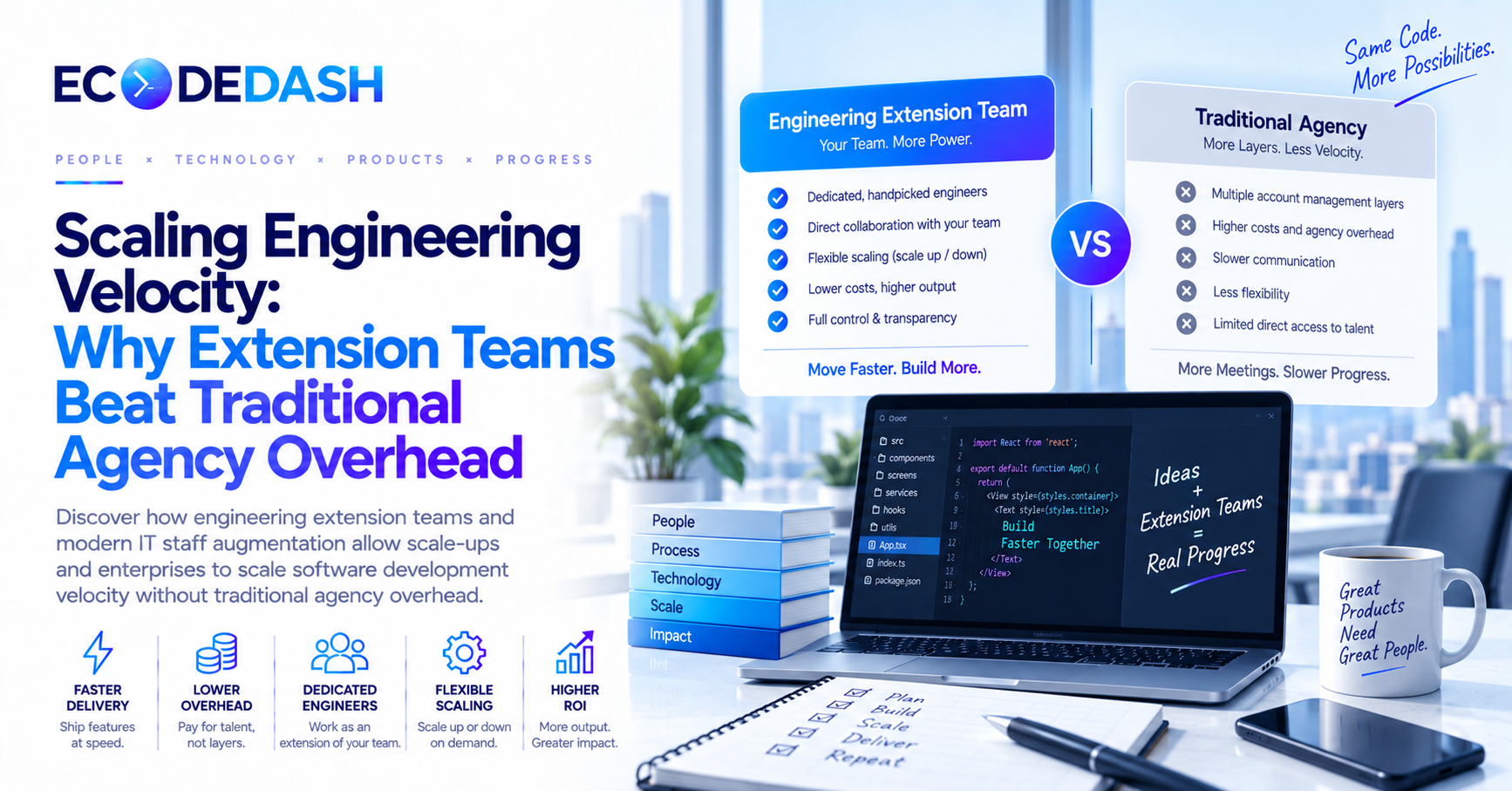
For high-growth scale-ups and modern enterprise technology organizations, product roadmap demands consistently outpace internal hiring capacity. Engineering leaders—from CTOs and VPs of Engineering to Heads of Product—face a continuous dilemma: recruit full-time in-house developers through slow, hyper-competitive domestic hiring funnels, or outsource critical initiatives to traditional project-based agencies that add heavy account management overhead and dilute architectural control.
Neither option suits modern continuous delivery cycles. A third paradigm—Engineering Extension Teams operating through modern, vetted staff augmentation models—has emerged as the standard for scaling technical capabilities rapidly, maintaining code ownership, and avoiding the friction of legacy agency contracts.

Clarifying the Model: The Core Definition of IT Staff Augmentation
When exploring talent strategies, technical executives often ask: How can the IT staff augmentation services definition be distinguished from legacy outsourcing or direct recruiting?
To evaluate the strategic value of scaling an engineering team, technical leaders must understand the operational taxonomy:
- Traditional Agency Outsourcing (Fixed-Scope / Black-Box): Work packages are handed off to an external agency. The vendor supplies project managers, designs architecture behind closed doors, and bills on milestones or fixed scopes. Internal engineering leaders often lose visibility into code quality, pull request velocity, and architectural debt.
- Direct In-House Recruiting: Hiring full-time employees directly. While offering maximal culture alignment, the time-to-hire frequently stretches from 60 to 120 days per senior engineer, accompanied by high overhead costs (recruiter fees, employer taxes, equity grants, and hardware provision).
- Engineering Extension Teams & IT Staff Augmentation: Senior external developers integrate directly into your sprint cycles, Slack channels, GitHub/GitLab repositories, and CI/CD pipelines. They report directly to your internal engineering managers, adopting your testing conventions, deployment cadence, and product vision.
Through Engineering Extension Team services, organizations secure dedicated specialized talent that functions identically to internal teammates while preserving operational flexibility and strict architectural oversight.
The Critical Challenges of Scaling an Engineering Team
Scale-ups transitioning through Series B and beyond, as well as mid-market enterprises undergoing digital modernisation, face predictable bottlenecks:
Scaling Bottlenecks:
┌──────────────────────┐     ┌──────────────────────┐     ┌──────────────────────┐
│  Time-to-Hire Lag    │ ──> │ Context & Onboarding │ ──> │ Architectural Drift  │
│  (60–120 Days / Eng) │     │ Overhead on Seniors  │     │ & Technical Debt     │
└──────────────────────┘     └──────────────────────┘     └──────────────────────┘
1. Niche Skill Scarcity
Whether modernizing mobile architectures with cross-platform frameworks, embedding real-time AI/ML pipelines, or refactoring monoliths into event-driven microservices, localized talent pools are frequently exhausted. Sourcing senior talent with specialized frameworks requires looking beyond local geographical borders.
2. High Context-Switching & Onboarding Friction
When teams onboard juniors or disjointed freelancers, senior engineering leads spend up to 40% of their sprints reviewing flawed PRs and conducting basic onboarding rather than building core platform architecture.
3. Runway Volatility and Demand Surges
Product roadmaps rarely move in a flat, linear trajectory. Feature launches, compliance deadlines (such as SOC 2 or HIPAA), and infrastructure migrations cause temporary spikes in engineering demand. Hiring permanent staff for temporary surges inflates fixed burn rates.
Outsourcing Software Development to a Dedicated Team: Structural Advantages
Adopting dedicated team software development transforms engineering operations across key dimensions:
| Evaluation Metric | Traditional Digital Agency | Direct Local Hiring | Engineering Extension Team |
|---|---|---|---|
| Time to Deployment | 4–8 weeks (scoping & contract) | 8–16 weeks (recruiting & notice) | 48–72 hours |
| Direct Code Visibility | Low (code delivered at milestone) | High (direct repo access) | High (integrated in daily PRs) |
| Workflow Integration | Standalone agency project managers | Internal Jira/Scrum | Directly in your daily Scrum/Jira |
| Cost Predictability | High markup, change-order fees | High fixed overhead & benefits | Predictable flat monthly rate |
| Scale Flexibility | Rigid contracts & scope renegotiation | High severance & legal friction | Elastic scale-up / scale-down |
Deep-Dive: Hiring High-Performance Mobile & Cross-Platform Engineers
To illustrate how extension teams solve specific technical bottlenecks, consider mobile application engineering. When scaling cross-platform mobile initiatives, finding engineers who bridge native performance with rapid cross-platform deployment is difficult.
How to Hire React Native Developers with Genuine Full-Stack Rigor
When vetting cross-platform mobile engineers, technical interviewers should look beyond basic UI layout skills. High-caliber React Native developers demonstrate mastery across:
- Native Module Bridging: Writing Swift/Objective-C and Kotlin/Java bridge components for low-latency device features (Bluetooth, camera streaming, native encryption).
- JSI and New Architecture (TurboModules & Fabric): Understanding the Javascript Interface (JSI) layer to avoid serialized bridge bottlenecks and improve thread concurrency.
- State Management & Memory Footprint: Implementing lightweight state architectures (Zustand, Redux Toolkit) and profiling memory leaks using Xcode Instruments and Android Profiler.
- CI/CD Mobile Pipelines: Automated build, signing, and distribution through Fastlane, App Center, and GitHub Actions.
Many scale-ups strategically hire React Native app developers in India and vetted international engineering hubs to access top 5% senior talent pools that have built mission-critical apps at scale.
Strategic Geography: Evaluating Global Talent Hubs
Engineering leadership must balance timezone overlap, technical rigor, and cost efficiency. Different global hubs serve complementary strategic needs:
IT Staff Augmentation Services in India
India represents one of the largest ecosystems of senior full-stack, AI, cloud, and mobile developers globally. Key advantages include:
- Deep Technical Infrastructure: High availability of developers experienced in enterprise distributed systems (Java/Spring, Golang, Python, AWS, React Native).
- Mature Agile Culture: Extensive experience collaborating in 24/7 follow-the-sun workflows, enabling accelerated sprint delivery for European, Middle Eastern, and North American teams.
- Unmatched Scalability: Ability to assemble cross-functional pods (2 backend, 2 frontend, 1 QA automation) in days.
IT Staff Augmentation Services in Canada and North America
For organizations requiring strict real-time timezone alignment with US Eastern/Pacific business hours or specific compliance constraints, North American staffing provides:
- Exact Timezone Synchronicity: Seamless real-time pairing across core product teams.
- Regulatory Alignment: Familiarity with North American enterprise compliance frameworks (PIPEDA, SOC 2, HIPAA).
Many forward-thinking CTOs employ a hybrid topology: an onshore technical architect or team lead paired with an extension squad in vetted international tech hubs.
Executive Playbook: Structuring Presentations, Proposals, and Contracts
When introducing dedicated extension teams to internal stakeholders, engineering leaders must navigate internal alignment, procurement scrutiny, and contract structuring.
1. Building the Internal Stakeholder Presentation
When engineering leaders ask, “How can an IT staff augmentation services presentation gain unanimous approval from the executive committee and finance?”, the answer lies in measurable engineering economics. A persuasive presentation for IT staff augmentation services must highlight:
- Opportunity Cost of Backlog Delays: Quantify how a 90-day hiring delay impacts customer churn or pipeline conversion.
- Burn-Rate Efficiency: Compare fully loaded domestic salaries ($160k base + 30% taxes/benefits + $25k recruiter bounty) against flexible extension team retainers.
- De-risking Capacity: Emphasize the ability to scale down without severance or layoff friction if macroeconomic conditions shift.
2. Evaluating Vendor Proposals
How can an IT staff augmentation services proposal be vetted to separate commoditized body shops from elite talent partners? A robust proposal for IT staff augmentation services should explicitly specify:
- Technical Vetting Scorecards: Documented multi-stage vetting (algorithms, system design, code review, communication).
- Named Senior Resources: Portfolios and GitHub track records of actual engineers matched to your stack, rather than placeholder profiles.
- Replacement Guarantees: Clear SLAs (e.g., replacement within 48–72 hours at zero additional onboarding cost if an engineer is not the right fit).
3. Key Clauses for the Staff Augmentation Contract
What can an IT staff augmentation services contract include to eliminate vendor lock-in while safeguarding sensitive assets? An enforceable contract for IT staff augmentation services must codify standard enterprise protections:
Key Contractual Protections:
├── 1. 100% Comprehensive IP Assignment (All code, commits, and architecture owned solely by client)
├── 2. Mutual NDA & Data Privacy (GDPR, SOC 2, zero local client data retention)
├── 3. Sprint-Based Flexibility (15–30 day notice period for team scaling)
└── 4. Transparent SLAs (Direct developer communication, sprint burndown tracking)
Onboarding Framework: Integrating Extension Developers in Under 5 Days
To ensure your engineering extension team reaches peak commit velocity within their first sprint, implement a structured onboarding blueprint:
Day 1: Access & Tooling Provisioning
- Single Sign-On (SSO) and passwordless authentication access to GitHub/GitLab, Jira, Slack, and cloud development environments.
- Automated local dev setup via Docker Compose or devcontainer configurations.
Day 2: Architecture & Workflow Walkthrough
- Deep dive into coding standards, branching strategies (GitFlow / trunk-based), and PR review criteria.
- Architectural overview of database schemas, API gateways, and external integrations.
Day 3: First "Good First Issue" Pull Request
- Assign a non-blocking bug fix or minor endpoint optimization to validate local build, testing suite, and CI/CD deployment pipelines.
Day 4–5: Full Sprint Integration
- Active participation in daily standups, backlog grooming, and paired programming sessions on core sprint epics.

Summary: Build Faster, Scale Smarter
Modern software competition rewards engineering velocity, resilience, and adaptability. Relying entirely on slow internal recruiting creates product bottlenecks, while delegating core IP to black-box agencies erodes technical control.
By leveraging dedicated, expert IT staff augmentation services, scale-ups and enterprises gain the elastic capacity to execute ambitious roadmaps, ship high-quality mobile and cloud platforms, and maximize capital efficiency.
Ready to eliminate engineering bottlenecks and augment your core team with pre-vetted senior developers within 48 hours? Schedule a consulting call to scale your engineering team with Ecode Dash today.