Ecode Dash Blog
The Enterprise Guide to IT Staff Augmentation Services: Frameworks, Regional Models, and Procurement Playbooks
A strategic enterprise playbook on IT staff augmentation services, covering procurement frameworks, compliance guidelines, regional talent hubs across the US, Canada, and India, and SLA standards.
By Ecode Dash Editorial Team · Software Engineering & Technology Consulting
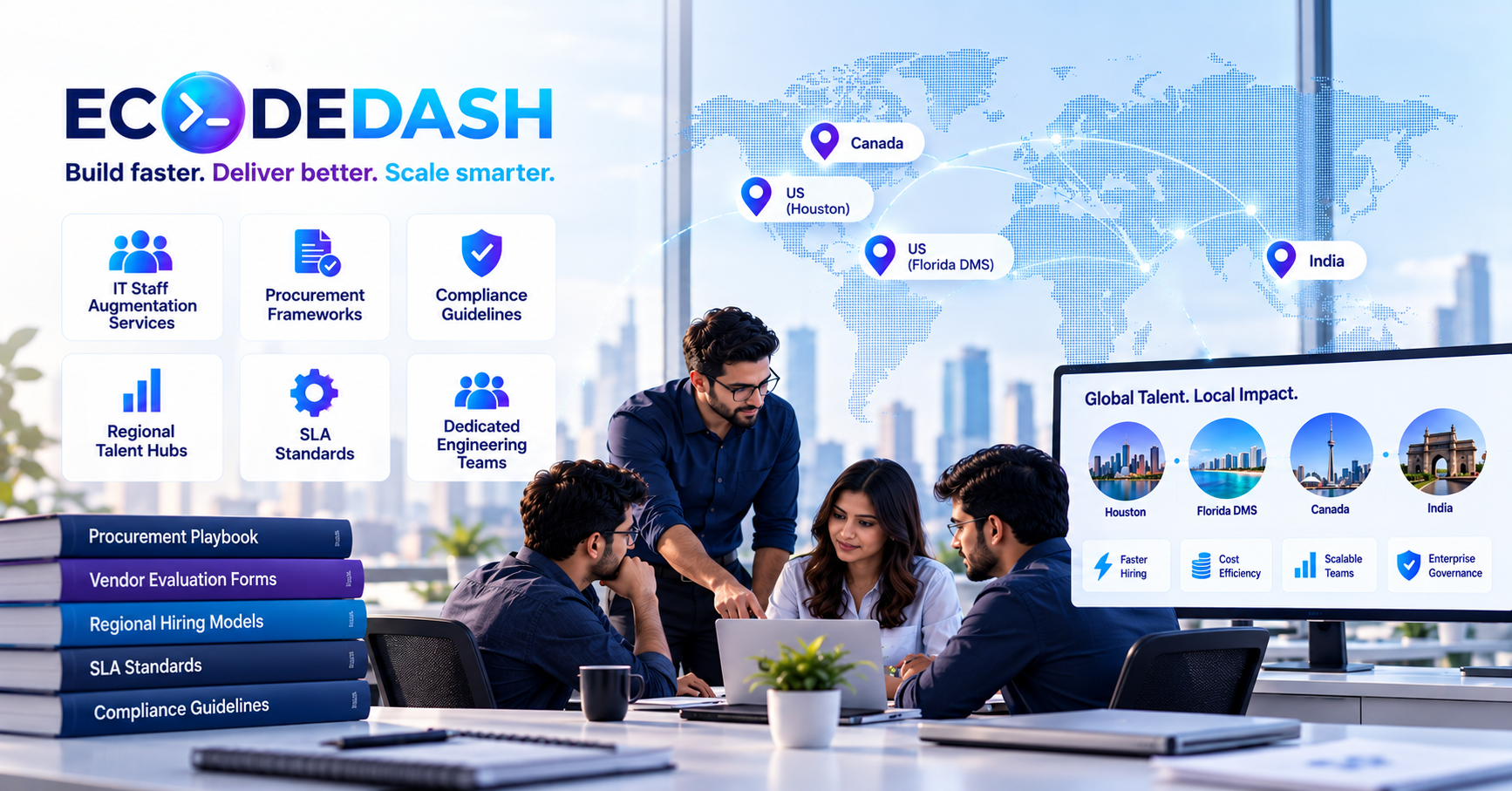
In an era where digital acceleration and AI integration dictate market leadership, engineering leaders and procurement executives face unprecedented friction in securing elite technical talent. Traditional recruiting cycles dragging beyond 90 days are no longer merely inconvenient—they directly degrade roadmap velocity, stall product releases, and compromise enterprise competitiveness.
Modern IT staff augmentation services have shifted from simple contingent labor backfilling into high-precision, strategic talent extensions. Whether scaling specialized AI/ML workflows, modernizing legacy enterprise SAP platforms, or deploying resilient cloud architectures, organizations must navigate an increasingly complex matrix of global hubs, procurement regulations, and operational frameworks.
This guide outlines the operational architectures, regional sourcing strategies, governance guidelines, and execution workflows necessary to build a high-velocity augmented engineering capability.
1. The Strategic Evolution of IT Staff Augmentation
To understand modern technical resourcing, engineering leaders must recognize how team extension models have matured over the past decade.
Evolutionary Stages of Technical Staffing:
Legacy Staffing (Pre-2020) ────> 2020 Remote Shift ────> Modern Agile Augmentation (AI-Curated Extensions)
   • Body shopping               • Ad-hoc remote hiring       • Pre-vetted domain specialists
   • Cost arbitrage focus        • Tooling fragmentation       • Time-zone aligned pods
   • High management overhead    • Variable code quality       • Integrated CI/CD & SLA governance
The Shift from Ad-Hoc Staffing to Integrated Engineering Extensions
Historically, staff augmentation was treated as a temporary transactional fix for capacity shortages. Legacy staffing paradigms focused primarily on cost arbitrage, often supplying junior or mismatched developers who required extensive ramp-up time.
By the 2020 transition—accelerated by global remote-work normalization—enterprises realized that distributed technical talent could outperform co-located teams when paired with disciplined agile governance. Today, augmentation has evolved into structured engineering extension teams. Companies partner with specialized providers who maintain rigorous multi-stage vetting pipelines (typically admitting only the top 3% to 5% of applicants), providing pre-vetted architects, full-stack engineers, and cloud specialists ready to contribute code within 48 to 72 hours.
2. Regional Talent Hubs: Comparative Dynamics
Engineering leadership must balance three critical vectors when architecting an augmented workforce: technical depth, cost efficiency, and operational synchronization. Different geographical corridors offer distinct strategic advantages.
United States Hubs: Houston, Florida, and Domestic Specialization
Domestic augmentation remains essential for initiatives requiring strict compliance, specific public sector clearances, or tight on-site collaboration.
- Texas & EnergyTech Corridors: Metropolitan regions like Houston have seen a surge in demand for specialized software engineering. Securing IT staff augmentation in Houston services heavily targets energy-transition platforms, IoT telemetry, enterprise logistics, and industrial cybersecurity. Engaging specialized IT staff augmentation Houston services allows engineering teams to deploy developers with deep domain knowledge in distributed systems and SCADA integration with zero onboarding friction.
- Florida & State Procurement Frameworks: Florida represents a high-growth corridor for healthtech, fintech, and public sector modernizations. Enterprise and public entities utilizing IT staff augmentation services Florida networks frequently operate under strict procurement standards, such as the Florida Department of Management Services (DMS) State Term Contracts. Utilizing compliant contracting vehicles under Florida DMS standards ensures that background vetting, rate transparency, and state regulatory mandates are strictly upheld.
Canada: The Nearshore North American Powerhouse
Sourcing IT staff augmentation services Canada options has emerged as a premier nearshore strategy for North American enterprises. Operating across identical time zones (EST to PST), Canadian engineering hubs in Toronto, Vancouver, Montreal, and Waterloo offer top-tier computer science graduates, robust intellectual property protections, and deep expertise in AI research, FinTech, and enterprise SaaS platforms.
India: Global Scale, Specialized Stacks, and AI Innovation
The partnership between global IT staff augmentation services and India-based engineering centers remains the cornerstone of software scalability. Beyond traditional volume, the Indian tech ecosystem has pivoted aggressively toward cutting-edge domains:
- Advanced AI & MLOps: Large talent pools specializing in PyTorch, generative AI engineering, Large Language Model (LLM) fine-tuning, and data pipeline orchestration.
- Enterprise ERP & Cloud Migration: Deep institutional expertise in SAP S/4HANA, Salesforce Core engineering, AWS/Azure cloud migrations, and distributed microservices (Golang, Rust, Java).
- Economic & Operational Leverage: Blended team models—combining domestic product management with offshore delivery pods in India—routinely generate 50% to 70% operational cost efficiencies while enabling continuous 24-hour development cycles.
Regional Delivery Comparison Matrix:
┌───────────────┬───────────────────────────────┬──────────────────────────┬────────────────────────────┐
│ Region        │ Core Strengths                │ Primary Tech Focus       │ Optimal Engagement Use     │
├───────────────┼───────────────────────────────┼──────────────────────────┼────────────────────────────┤
│ United States │ Real-time sync, compliance    │ Architecture, SecOps,    │ Core leadership, regulated │
│ (e.g. TX, FL) │ & public sector frameworks    │ GovTech, Energy IoT      │ systems, state contracts   │
├───────────────┼───────────────────────────────┼──────────────────────────┼────────────────────────────┤
│ Canada        │ Zero timezone delta, IP laws, │ Enterprise SaaS, AI/ML,  │ High-velocity sprints,     │
│               │ cultural alignment            │ Cloud-native engineering │ nearshore sprint teams     │
├───────────────┼───────────────────────────────┼──────────────────────────┼────────────────────────────┤
│ India         │ Unmatched talent depth, 24/7  │ Full Stack, Data Eng,    │ Core platform scaling,     │
│               │ development cycles, economics │ GenAI, SAP, Automation   │ 24/7 delivery pipelines    │
└───────────────┴───────────────────────────────┴──────────────────────────┴────────────────────────────┘
3. Governance Frameworks, Standards, and Methodologies
Successful augmentation programs operate on mature, documented operational frameworks. Sourcing technical personnel without rigid governance introduces technical debt, communication silos, and integration failure.
Alignment with Evolving Project Management Standards
Modern talent augmentation methodologies reflect the continuous maturation of project management and service governance standards:
- Process-Driven Foundations (5th Edition Standards): Early frameworks established structured procurement plans, input/output controls, and formal contract administration.
- Agile Alignment & Hybrid Delivery (6th Edition Evolution): The industry expanded to accommodate iterative sprints, blended teams, and collaborative product roadmaps alongside traditional milestones.
- Value Delivery and Outcome Focus (7th Edition PDF Principles): Contemporary governance prioritizes system-wide value delivery, developer adaptability, proactive risk management, and outcome-oriented KPIs rather than pure headcount tracking.
By integrating these modern governance principles, engineering leadership ensures that external talent is evaluated against verifiable system design and algorithmic performance rubrics rather than generic resumes.
Public Sector & Sovereign Procurement Guidelines
Governmental and municipal bodies (such as standard state frameworks in the US or national procurement portals such as Sri Lanka's `gov.lk` ICTA procurement directives) establish rigorous procurement baselines. These IT staff augmentation services guidelines mandate transparent bidding formats, fixed rate cards, clear IP ownership covenants, and comprehensive indemnity terms. Enterprise leaders can adopt these same public procurement best practices to de-risk commercial vendor contracts.
How Enterprises Buy and Sell Augmented Capabilities
In the modern B2B ecosystem, mature organizations both consume and sell specialized engineering capacity. Companies looking to buy or deliver IT staff augmentation services and sell specialized pods to strategic partners must clearly articulate SLAs, delivery velocity, stack proficiencies, and replacement guarantees to create sustainable commercial relationships.
4. The Procurement Playbook: From RFP to Developer Onboarding
Securing top-tier technical talent requires a standardized, frictionless procurement and vetting pipeline.
Augmentation Procurement Lifecycle:
[ Requirement Discovery ] ────> [ Vendor RFP & Intake ] ────> [ Technical Vetting ] ────> [ 48-Hr Onboarding ]
        │                             │                            │                         │
        ▼                             ▼                            ▼                         ▼
Define stack, level,           Standardized intake        Multi-stage code eval,      Zero-trust access,
and delivery timeline.        form & SLA agreements.       architecture review.      CI/CD integration.
Step 1: Standardized Intake & Requirement Formulation
Avoid generic recruiter outreach. The procurement process should initiate with a comprehensive IT staff augmentation services form detailing:
- Exact Technology Stack & Ecosystem: e.g., React, Node.js, Python FastAPI, AWS Lambda, Snowflake, Kubernetes.
- Seniority & Role Definition: Architectural leadership, hands-on IC (Individual Contributor), or QA automation specialist.
- Working Hours & Overlap Requirements: Minimum required synchronous working overlap (typically 4 hours minimum for distributed teams).
- Security & Compliance Constraints: SOC2 Type II, HIPAA, GDPR, or state-specific regulatory compliance.
Step 2: Vendor Evaluation and RFP Communications
When issuing an IT staff augmentation services email or formal Request for Proposal (RFP), structure vendor communications around precise evaluation criteria:
Sample Vendor Inquiry & Evaluation Template:

Subject: Request for Engineering Extension Profiles — [Stack: e.g., AI/ML & Python Backend]

Dear [Partner/Vendor],

We are currently expanding our core platform engineering pod and require [Number] Senior [Role Name] to integrate into our active sprint team.

Key Requirements:
1. Core Tech Stack: [List primary & secondary stacks]
2. Experience Level: 5+ years with production distributed systems
3. Timezone Coverage: Minimum 4 hours daily overlap with [Timezone, e.g., EST]
4. Target Start Date: Within [X] days

Please supply anonymized technical profiles, code repository samples, and rate structures within 48 hours. Submissions must confirm multi-tier technical vetting, IP assignment terms, and developer replacement guarantees.
Step 3: Multi-Stage Technical and Cultural Vetting
Enterprise engineering leaders should only review pre-screened talent. Top talent providers deploy a multi-stage validation gauntlet:
- Phase 1: Automated Coding & Problem Solving: Live algorithmic evaluation and real-world coding benchmarks.
- Phase 2: System Design & Architecture: Deep-dive interviews covering concurrency, database optimization, scalability, and security hygiene.
- Phase 3: Communication & Collaboration: Testing async communication clarity, team problem-solving dynamics, and English fluency.
By leveraging structured Engineering Extension Team services, companies bypass the noise of open job boards, reviewing only the top 5% of candidate profiles within 48 hours.
5. Security, IP Protection, and Operational Best Practices
Integrating external developers into your proprietary codebases requires uncompromising security protocols.
Intellectual Property (IP) Protection
Ensure all master service agreements (MSAs) and statements of work (SOWs) contain unambiguous work-for-hire provisions. IP ownership must transfer automatically upon code creation, backed by robust non-disclosure agreements (NDAs) enforceable across the vendor's legal jurisdiction.
Zero-Trust Access Architecture
Never grant augmented personnel unmonitored or unsegmented access to core infrastructure:
- Identity and Access Management (IAM): Deploy least-privilege role-based access control (RBAC). Require Single Sign-On (SSO) and Multi-Factor Authentication (MFA) across all repositories and communication tools.
- Isolated Development Environments: Use cloud workstations or virtual development environments (e.g., GitHub Codespaces, AWS WorkSpaces) to prevent source code from being downloaded onto local machines.
- Automated Code Scanning: Enforce automated static application security testing (SAST), secret scanning, and dependency vulnerability checks on every pull request prior to merging.
Security Best Practices Checklist:
[✓] Role-based access control (RBAC) configured to least privilege.
[✓] Ephemeral access tokens and SSO/MFA enforced across all tools.
[✓] Work-for-hire and IP assignment contracts executed across jurisdictions.
[✓] Code stored on secure, monitored cloud repositories with secret-leak scanning.
[✓] No direct developer access to production databases or unmasked PII.
6. Measuring ROI: Key Performance Indicators for Augmented Teams
To ensure your augmented talent drives measurable business outcomes, monitor these four critical operational dimensions:
- Time-to-Productivity (TTP): The number of days from contract signing to the engineer's first merged production pull request. Elite augmentation workflows achieve a TTP of under 5 to 7 days.
- DORA Metrics (Velocity & Reliability):
- Deployment Frequency: Pace of successful code releases.
- Lead Time for Changes: Duration from commit to production deployment.
- Change Failure Rate: Percentage of deployments causing production defects.
- Mean Time to Recovery (MTTR): Speed of restoring service during incidents.
- Sprint Completion Rate: The ratio of committed story points versus delivered story points per sprint cycle.
- Cost per Merged Feature: Comparing fully burdened internal hiring costs (recruiter fees, benefits, payroll taxes, equipment, onboarding lag) against fixed, hourly or retainer-based augmentation costs.
Conclusion: Accelerating Your Roadmap with Precision Augmentation
Engineering team scaling is no longer a choice between slow internal recruiting and risky, unvetted outsourcing. Modern enterprise staff augmentation provides a third, superior path: pre-vetted, high-caliber domain experts seamlessly integrated into your sprint cycles within days.
By establishing clear governance, leveraging strategic global and nearshore talent corridors, and executing disciplined procurement workflows, engineering organizations can eliminate talent bottlenecks and accelerate their product delivery milestones.
Ready to eliminate hiring delays and scale your engineering capacity? Connect with our team to scale your technical team with pre-vetted engineers and deploy senior developers within 48 hours.