Ecode Dash Blog
Hire Dedicated React Native Developers: A Two-Week Onboarding Guide
A practical playbook for engineering leads adding a dedicated React Native developer to an existing app team. Covers codebase access and environment setup, written release ownership, code review expectations, sourcing through four-stage vetting, and a realistic day-by-day react native developer onboarding plan for the first two weeks.
Access delays and ambiguous release ownership can derail an external mobile developer's first two weeks, even when the hiring decision itself was sound. Engineering leads who hire dedicated React Native developers for an existing app team confront four operational decisions immediately after the contract is signed: environment access, release ownership, review norms, and a workable schedule. This guide resolves each decision with concrete defaults and closes with a day-by-day plan that can be reused for every subsequent hire.
Key takeaways
- Pre-provision scoped codebase, toolchain, and secrets access before day one, because every day of setup delay compounds into lost architectural context.
- Put release ownership in writing during week one, and govern store binaries and any over-the-air (OTA) JavaScript channel separately.
- Codify review expectations early: pull request size limits, turnaround targets, and the code paths that require two approvals.
- Structure week one around a single small merged pull request, and treat production shipping as conditional on the team's normal release schedule.
- Source through a vetted route with a replacement guarantee, so a mismatch becomes a remediation event rather than a sunk engagement.
At a glance
- Setup window: plan for two to three working days when access is pre-provisioned, and a week or more when it is not (planning assumption, not benchmark data).
- Release ownership default: the in-house lead remains accountable for store releases in month one; the new developer shadows the process, then rotates into a release captain role.
- Review turnaround target: one business day for standard pull requests, four hours for release blockers (recommended targets, not measured results).
- First milestone: one merged pull request by day five; shipping follows the team's existing release schedule.
- Sourcing route: Ecode Dash's Hire by Stack route typically provides vetted React Native profiles within 48 hours, following a four-stage vetting process and backed by a replacement guarantee (Ecode Dash, 2026).
What should you provision before a dedicated React Native developer starts?
Provision everything before day one: repository access with scoped permissions, the project board, CI/CD (continuous integration and continuous delivery) dashboards, build and signing visibility, secrets, test devices, and the channels where decisions actually happen. A dedicated React Native developer who waits a week for credentials learns nothing about the architecture and loses the momentum that makes the early weeks productive.
The setup list for a React Native hire runs longer than for a web hire, because the toolchain spans two native platforms in addition to the JavaScript layer. Work through the following items in order, and treat the list as a living document that every new hire stress-tests.
- Repository and monorepo access. If the application lives in a monorepo (a single repository holding multiple packages), document the workspace layout and the build order explicitly. Name the package manager, whether npm, Yarn, or pnpm, because those conventions are rarely obvious from the directory tree alone.
- Native toolchain versions. Pin Xcode and CocoaPods for iOS, and Android Studio, the JDK, and Gradle for Android, recording every version in a README or a tool-version file. Version drift is a common cause of "works on my machine" failures, and pinning versions is the cheapest available insurance against it.
- Environment variables and secrets. Provide staging API endpoints, analytics keys, and feature flag access (a feature flag is a runtime switch that toggles functionality without redeployment). Distribute secrets through a secrets manager rather than a shared document, so access can be revoked cleanly if the engagement ends.
- Build and signing infrastructure. Grant access to Expo Application Services (EAS) or the in-house build pipeline, along with read-only visibility into who owns the signing certificates. When release blockers route to the right person on the first attempt, week-two shipping stops depending on informal escalation.
- Physical test devices or a device farm. Provide at least one iOS and one Android device profile, since physical devices help validate hardware and notification behavior that simulators may not fully reproduce.
A hypothetical illustration clarifies why this sequencing matters. Imagine an engineering lead who condenses these five items into a one-page day-zero checklist before the developer's start date. In that scenario, the new hire can plausibly run the application locally on day one, whereas a hire without the checklist might spend the week chasing credentials across three departments. Treat those outcomes as planning targets rather than measured benchmarks.
Who should own releases when you hire dedicated React Native developers?
Keep store release ownership in-house for the first month, then rotate the responsibility deliberately. Write a RACI matrix (responsible, accountable, consulted, informed) in which the in-house lead is accountable for releases and the incoming developer is responsible for release preparation. Both parties should be consulted on rollback decisions, and the matrix should exist before week one ends.
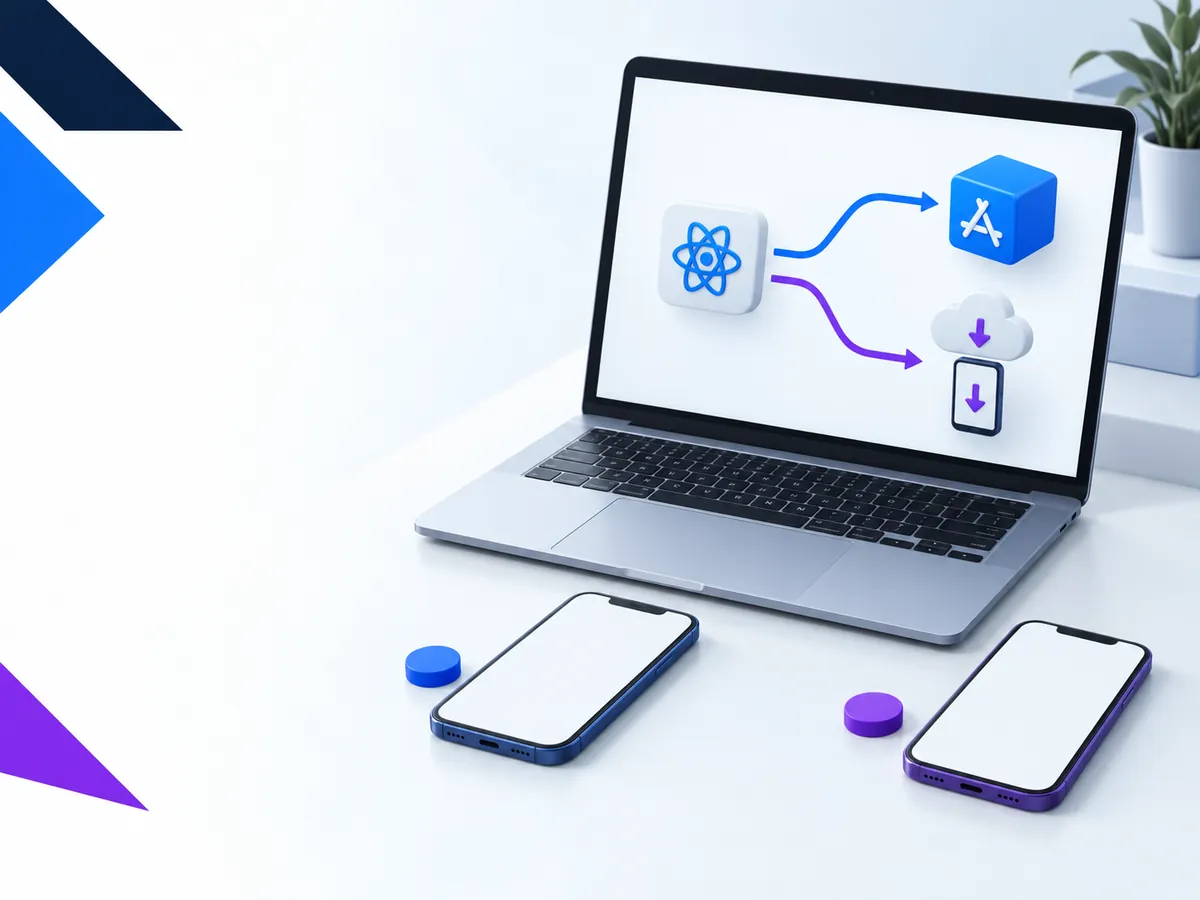
React Native release governance carries two potential layers that inexperienced teams often conflate. Store binaries pass through App Store and Google Play review, and any change to native code requires a new binary submission. Some teams additionally deliver JavaScript-only fixes through an OTA channel such as Expo Updates or a comparable mechanism, which bypasses store review entirely for that layer.
Assign an owner to each layer separately, because the failure modes differ. The store binary owner controls version bumps, release notes, and phased rollouts, while the OTA owner controls which JavaScript fixes ship instantly and which wait for the next binary. When a single accountable person owns both during the first month, the new developer can shadow the complete cycle before rotating into a release captain role in month two.
The framework's own positioning supports this division of labor, since the JavaScript layer is where most daily iteration occurs.
"Create native apps for Android, iOS, and more using React." (React Native documentation, 2025)
Share on LinkedIn · Share on X
What code review expectations should you set in week one?
Set four expectations in writing during the first week: maximum pull request size, review turnaround targets, the code paths that require two approvals, and the convention for review comments. Prompt, predictable reviews keep an external developer's work unblocked and prevent the quiet accumulation of unreviewed branches that erodes trust on both sides.
Practical defaults work better than aspirational ones. Cap pull requests at roughly 400 lines of changed code so reviewers can respond within the agreed window, and require two approvals for native module changes, signing configuration, and CI pipeline edits. Define a comment taxonomy (blocking, suggestion, question) so a new reviewer never has to guess whether a remark gates the merge.
The value of prompt reviews is operational rather than statistical. When feedback arrives within one business day, the developer revises code while the context is still fresh, the team's release cadence stays intact, and small misunderstandings about conventions surface in week one instead of month two. Slow reviews produce the opposite compounding effect: stale branches, duplicated effort, and a new hire who learns to work around the process rather than within it.
What does a realistic react native developer onboarding plan cover in the first two weeks?
A realistic react native developer onboarding plan covers environment verification, one merged pull request, a release shadowing pass, and a scoped feature with full test coverage. Production shipping remains conditional on the team's release schedule rather than the calendar. Write the react native developer first two weeks plan down and have both parties sign off before day one.
The day-by-day structure below assumes pre-provisioned access and a senior external hire.
- Day 1: Verify the local build on both platforms, walk the architecture with the in-house lead, and review the RACI matrix and review norms document.
- Days 2 to 3: Pick a deliberately small first task, such as a copy change behind a feature flag or a minor bug with a known reproduction path, and open the first pull request.
- Days 4 to 5: Address review feedback, merge the first pull request, and observe how CI handles the merge through to a staging build.
- Days 6 to 7: Begin a scoped feature with an agreed definition of done, and shadow the in-house lead through one complete release or release-preparation cycle.
- Days 8 to 9: Implement the feature with unit tests, request review, and pair on any native bridge or module work the task touches.
- Day 10: Retrospective with the engineering lead covering access gaps, review friction, and whether the developer is ready to rotate into release duties in month two.
Two failure patterns deserve explicit mention. The first is assigning a sprawling legacy bug as the introductory task, which conflates onboarding with archaeology and produces a demoralizing first week. The second is skipping the day-ten retrospective, which forfeits the cheapest available audit of the onboarding process itself.
How should you hire dedicated React Native developers without restarting the search?
The most reliable way to hire dedicated React Native developers without absorbing a second search cycle is to use a vetted route with a written replacement guarantee. Ecode Dash's Hire by Stack route follows a four-stage process: requirement discovery, AI-powered talent curation, multi-stage vetting and validation, and interview, onboard, and scale (Ecode Dash, 2026).
The fourth stage deserves careful reading, because it separates two events that procurement documents often merge. Receiving profiles typically happens within 48 hours of the requirement being understood (Ecode Dash, 2026), but receiving a profile is not the same as completing onboarding. The onboarding work described in this guide, from environment provisioning through the day-ten retrospective, remains the hiring team's responsibility regardless of how strong the sourced candidate is.
Geography belongs in the requirement-discovery conversation rather than as an afterthought. Ecode Dash serves clients across India, Singapore, Europe, and the UAE, with teams structured for timezone alignment and clear English communication (Ecode Dash, 2026). A company looking to hire React Native developers in India, or to staff a react native staff augmentation engagement from any of those markets, should state its overlap hours and communication expectations at the discovery stage rather than after profiles arrive.
The replacement guarantee is the contractual backstop for everything above. Ecode Dash replaces any developer who is not meeting expectations, quickly and without extra cost (Ecode Dash, 2026), which converts a potential mismatch from a sunk engagement into a managed remediation. That guarantee matters most in week three and beyond, after the onboarding investment has been made and the cost of a restart is highest.
What this means for you
If you are an engineering lead preparing for an external React Native hire, sequence the work this week rather than on the developer's start date. Draft the day-zero access checklist and the RACI matrix now, circulate the review norms document to existing reviewers before the hire arrives, and select the small first task in advance. When sourcing is still open, route the requirement through a vetted channel with a replacement guarantee so the onboarding investment is protected, and treat the 48-hour profile turnaround as the start of onboarding rather than its completion.
Frequently asked questions
How long does react native developer onboarding take for a senior external hire?
Plan for two structured weeks to reach a merged pull request, a shadowed release cycle, and a scoped feature in review. Full autonomy on release duties typically follows in month two, after the developer has rotated through a supervised release.
Should a dedicated React Native developer get production access immediately?
No. Scope initial access to repositories, staging environments, and read-only visibility into signing and release infrastructure. Expand permissions after the first supervised release cycle, which keeps both security posture and accountability intact.
What is the difference between hiring a dedicated developer and react native staff augmentation?
The terms overlap heavily in practice. React native staff augmentation usually describes adding individual external engineers to an existing team under your management, while a dedicated developer engagement emphasizes longer-term exclusive allocation. Both models depend on the same onboarding discipline described in this guide.
How quickly can a vetted partner provide React Native candidates?
Ecode Dash typically provides profiles within 48 hours once the requirement is understood, following requirement discovery, AI-powered curation, and multi-stage vetting (Ecode Dash, 2026). Profile delivery and completed onboarding are separate events, and the hiring team owns the second one.
What happens if the external developer does not work out?
Under Ecode Dash's replacement guarantee, any developer who is not meeting expectations is replaced quickly and without extra cost (Ecode Dash, 2026). Documenting review norms and two-week milestones gives both parties objective evidence for that decision.
Sources
- React Native official documentation, framework overview (reactnative.dev, 2025).
- Ecode Dash website, hiring process, served markets, and replacement guarantee descriptions (ecodedash.com, 2026).
- Setup windows, turnaround targets, and milestone timings in this article are planning assumptions and recommended defaults, not benchmark data.
Related resource
Engineering Leadership · Mobile Development · hire dedicated react native developers · hire react native developers in india · react native developer onboarding · dedicated react native developer · react native staff augmentation · react native developer first two weeks