Ecode Dash Blog
Scaling Engineering Capacity: The Strategic Guide to IT Staff Augmentation and Dedicated Teams
Discover how engineering leaders scale capacity seamlessly with IT staff augmentation and dedicated teams. Learn contractual models, proposal strategies, global hiring hubs, and how to hire top React Native developers.
By Ecode Dash Editorial Team · Software Engineering & Technology Consulting
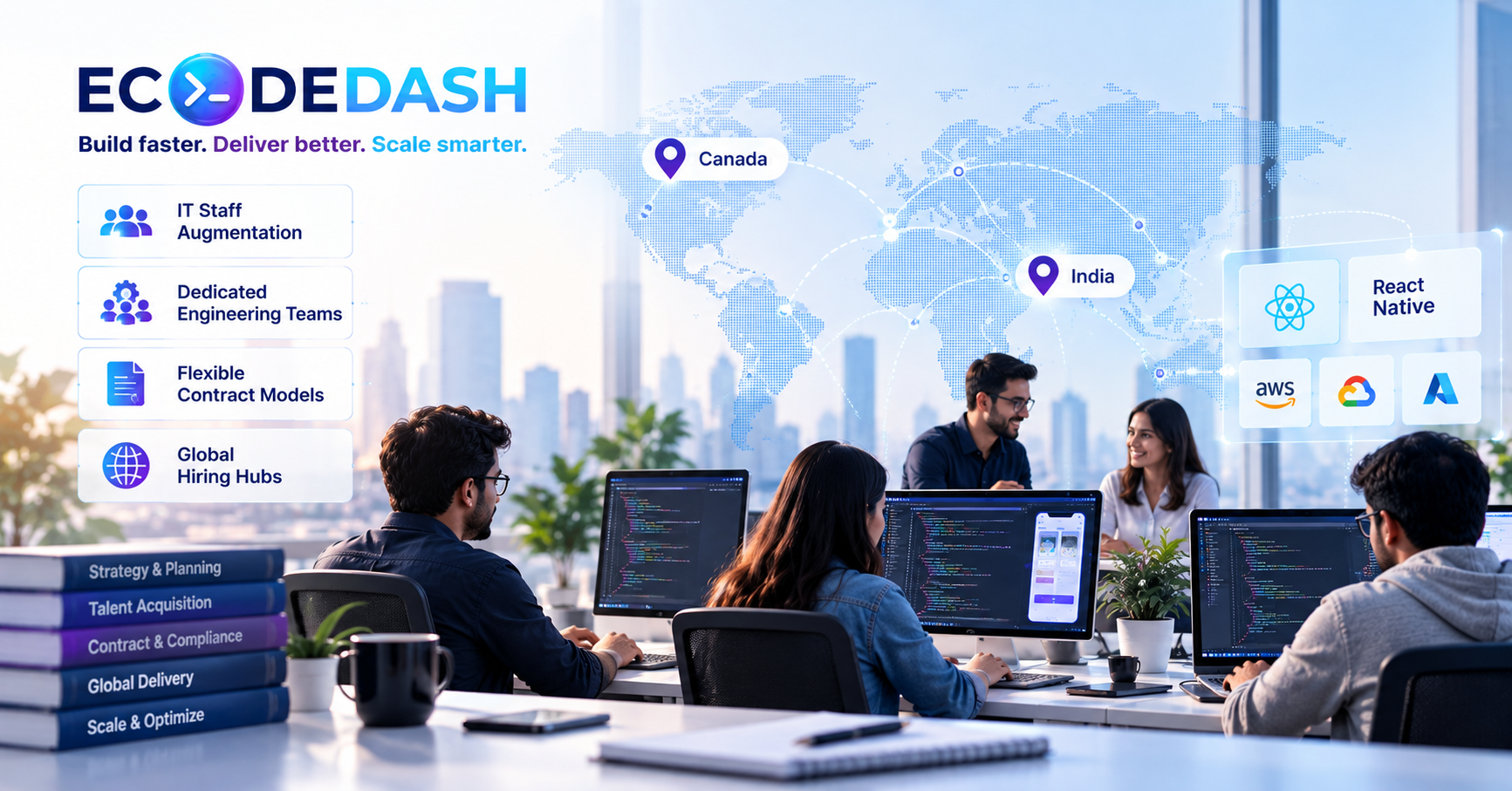
Engineering leaders face intense pressure to accelerate product roadmaps, deploy modern architectures, and maintain high code quality—often under tight headcount constraints and aggressive deadlines. When internal recruitment cycles take months and specialized skills are scarce, organizations must look beyond traditional hiring funnels.
Building sustainable software delivery capacity requires a clear understanding of modern scaling models. Whether integrating high-performing engineers into an established squad or setting up an autonomous external unit, choosing the right framework determines both velocity and long-term maintainability.
Understanding IT Staff Augmentation: Definition and Core Mechanics
To build an effective talent strategy, technology executives must first clarify what staff augmentation entails compared to other outsourcing models.
The Operational Definition of IT Staff Augmentation
IT staff augmentation is a flexible workforce model where an external partner supplies specialized technical talent to directly complement an in-house engineering team. Unlike turnkey project outsourcing, augmented developers become direct extensions of your day-to-day operations. They attend your daily standups, commit code to your repositories, follow your CI/CD pipelines, and report directly to your internal engineering managers.
This model is designed to plug specific skill gaps, manage short-to-medium-term workload surges, or accelerate feature delivery without incurring the long-term overhead of permanent recruitment, local payroll infrastructure, and full-time benefits.
Comparing Engagement Models: Augmentation vs. Dedicated Teams vs. Project Outsourcing
Selecting the right collaboration structure depends on project scope, governance, and management bandwidth:
| Engagement Dimension | IT Staff Augmentation | Dedicated Engineering Team | End-to-End Project Outsourcing |
|---|---|---|---|
| Management Control | Internal (Your team leads daily tasks) | Hybrid (Shared roadmap; partner manages execution) | Vendor-led (Outcome and milestone-focused) |
| Core Advantage | Instant skill injection and direct oversight | Scaled operational velocity with autonomous squads | Minimal internal management overhead |
| Integration Level | Deeply embedded in existing sprints | Aligned with your architecture and delivery goals | Loosely coupled via external deliverables |
| Best Used For | Filling niche tech gaps or burst capacity | Long-term roadmap expansion and new product lines | Standalone MVPs or non-core legacy refactoring |
When scaling software systems, many enterprises combine models—using staff augmentation for critical core services while outsourcing software development to dedicated team structures for greenfield initiatives.
The Core Challenges of Scaling an Engineering Team
Scaling an engineering organization is rarely as simple as adding more developers to a sprint. As team size increases linearly, communication overhead and architectural complexity grow exponentially.
Scaling Bottlenecks:

[ Hiring Lag: 60-90 Days ] ──> [ Onboarding Friction ] ──> [ Cultural & Timezone Misalignment ]
                                        │
                                        ▼
                            [ Slower Sprint Velocity & Debt ]
1. Protracted Recruitment Timelines
Sourcing senior engineers with niche expertise—such as distributed systems, cloud-native DevOps, or cross-platform mobile frameworks—typically takes between 60 to 90 days in competitive domestic markets. This hiring lag directly stalls strategic release dates.
2. High Context-Switching and Onboarding Friction
Injecting junior or unvetted personnel into complex codebases strains senior architects who must spend disproportionate time reviewing pull requests, debugging environment setups, and resolving basic framework misunderstandings.
3. Knowledge Silos and Tech Debt Accumulation
Rapid, uncoordinated team growth often leads to fragmented architectures. Without disciplined code standards and rigorous integration practices, distributed teams risk introducing regression issues and technical debt.
4. Cross-Border Timezone and Communication Barriers
Poorly structured global delivery partnerships frequently struggle with synchronous collaboration gaps, delayed blocker resolution, and misaligned product expectations.
Addressing these hurdles requires partnering with providers of flexible engineering extension teams that enforce strict multi-stage technical screening and timezone-aligned workflows.
How to Build a Compelling Business Presentation and Executive Proposal
Securing executive and board-level buy-in for external engineering partnerships requires presenting a clear commercial and operational justification.
Structuring the Internal Executive Presentation
When presenting a staff augmentation strategy to the CTO, VP of Product, and CFO, focus on measurable business impact:
- Capacity vs. Roadmap Analysis: Map current sprint velocity against pending deliverables to visualize the delivery deficit.
- Total Cost of Engagement (TCE): Contrast the fully burdened cost of local hiring (recruiting fees, equity, benefits, equipment, severance) against the operational elasticity of augmented staffing.
- Risk Mitigation Framework: Detail how IP protection, secure VPN environments, and automated vetting protect codebase integrity.
- Time-to-Value Metrics: Show how pre-vetted engineers reducing ramp-up time from 10 weeks to 48–72 hours accelerates product time-to-market.
Critical Components of a Robust Staff Augmentation Proposal
When evaluating vendor proposals—or creating an RFP for external talent partners—ensure the following elements are explicitly defined:
- Scope & Technical Profiling: Granular breakdown of technical stacks, seniority benchmarks, and repository-level responsibilities.
- Service Level Agreements (SLAs): Candidate profile delivery timelines (e.g., 48-hour turnarounds), immediate replacement guarantees, and onboarding benchmarks.
- Billing & Utilization Metrics: Clear hourly, blended, or monthly sprint-rate models without hidden administrative or platform fees.
- Governance Cadence: Defined bi-weekly code-quality reviews, velocity scorecards, and sprint retrospectives.
Mastering the Staff Augmentation Contract: Legal, Compliance, and IP Clauses
An enterprise-grade contract ensures compliance, shields proprietary code, and sets clear expectations. Engineering leaders must review key contractual mechanisms before signing.
Key Contractual Pillars:
├── Master Services Agreement (MSA)  ──> Governance, IP Assignment, Liability Limits
├── Statement of Work (SOW)          ──> Specific Roles, Tech Stacks, Rates & Milestones
└── Security & NDA Schedules         ──> SOC2, GDPR/CCPA, Zero-Trust Access Policies
1. Strict Intellectual Property (IP) Assignment
The contract must explicitly state that all deliverables, code commits, documentation, schemas, and algorithmic enhancements created by augmented engineers belong unconditionally to your organization from the moment of creation. Ensure global work-for-hire clauses apply across all jurisdictions.
2. Comprehensive Non-Disclosure & Data Protection
Protect proprietary architectures with strict non-disclosure terms. Specify compliance standards such as GDPR, SOC 2, or HIPAA where applicable, ensuring remote personnel operate on isolated environments or virtual desktop infrastructure (VDI).
3. Transparent Replacement and Warranty Terms
Expert IT staff augmentation services include built-in trial periods and zero-friction replacement clauses. If a developer fails to meet technical or cultural benchmarks within the initial 14-day window, the vendor should provide a qualified replacement immediately at no extra onboarding charge.
4. Non-Solicitation and Termination Flexibility
Balance mutual protection with operational agility. Contracts should provide flexible 30-day scale-down terms while defining explicit pathways for long-term contract-to-hire arrangements if both parties agree.
Global Talent Hubs: Navigating India, Canada, and Nearshore Regions
Modern engineering organizations leverage global talent hubs to create round-the-clock delivery cycles and access deep talent reserves.
IT Staff Augmentation Services in India
India remains the premier global hub for software engineering, offering unmatched scale, deep expertise in emerging technologies, and robust technical education pipelines.
- Massive Talent Pool: India produces over 1.5 million engineering graduates annually, with mature hubs in Bengaluru, Hyderabad, Pune, and the National Capital Region (NCR).
- Deep Stack Maturity: Strong specialization in cloud infrastructure, enterprise backend systems (Java, Python, Go, Node.js), AI/ML engineering, and cross-platform mobile frameworks.
- Economic Efficiency: Enables high capital efficiency while securing top-tier senior talent who seamlessly integrate into Western development cadences.
IT Staff Augmentation Services in Canada
For organizations prioritizing exact time-zone synchronization and North American operational alignment, Canada has emerged as a premier technology ecosystem.
- Nearshore & Onshore Proximity: Hubs like Toronto, Vancouver, and Montreal operate entirely within North American time zones (EST, PST), facilitating seamless real-time sprint participation.
- Regulatory Familiarity: Similar labor practices, legal frameworks, and intellectual property enforcement standards simplify cross-border contracting.
- Immigration & Tech Hubs: Canada's progressive tech visa programs have attracted top international engineering talent, creating dense hubs of senior architectural expertise.
Special Focus: How to Hire React Native Developers for Scalable Mobile Delivery
Cross-platform mobile engineering demands developers who understand both high-level JavaScript/TypeScript paradigms and the low-level native runtime environments of iOS and Android. Hiring elite React Native talent requires targeted evaluation.
React Native Candidate Evaluation Matrix:

[ Core TypeScript / React Native Architecture ]
                       │
                       ▼
[ Native Bridge & JSI / TurboModules Mastery ]
                       │
                       ▼
[ Memory Profiling, Threading & Reanimated 3 ]
                       │
                       ▼
[ CI/CD Mobile Automation (Fastlane, TestFlight) ]
Step-by-Step Framework: How to Hire React Native Developers
- Screen for True Native Bridge Understanding: A senior React Native engineer must understand how the JavaScript runtime communicates with native threads. Evaluate their knowledge of the New Architecture (Fabric renderer, TurboModules, and the JavaScript Interface / JSI).
- Assess Real-World Performance Optimization: Probe their ability to diagnose UI frame drops, optimize heavy list rendering using FlashList, handle memory leaks, and implement smooth 60 FPS animations using React Native Reanimated.
- Test State Management & Offline-First Design: Assess architecture patterns using Redux Toolkit, Zustand, or TanStack Query, alongside local caching mechanisms like SQLite or WatermelonDB.
- Evaluate Mobile DevOps & Deployment Pipelines: Ensure candidates possess hands-on experience setting up automated build pipelines with Fastlane, managing code signing certificates, and deploying updates via CodePush or Expo Application Services (EAS).
Why Global Enterprises Hire React Native App Developers in India
India has established a dense ecosystem of mobile engineers who have built and maintained consumer-scale applications serving hundreds of millions of users across e-commerce, FinTech, and media platforms.
When hiring React Native engineers from India, enterprises benefit from:
- High-Volume Production Experience: Engineers accustomed to high-concurrency architectures and edge-case mobile device fragmentations.
- Full-Stack Fluency: Candidates who seamlessly navigate both the mobile client and backend Node.js or GraphQL microservices.
- Accelerated Time-to-Hire: Rapid sourcing through vetted networks that compress hiring cycles from months to under 48 hours.
Dedicated Team Software Development: When to Pivot from Augmentation
While staff augmentation solves specific bandwidth and skill deficits, setting up a dedicated software development team is the superior strategy for long-term, end-to-end initiatives.
Key Indicators for Dedicated Squad Deployment
- Greenfield Product Lines: When building a new standalone product or rewriting legacy architecture from the ground up.
- Need for Autonomous Delivery: When internal management bandwidth is fully consumed by core operations and you require an external engineering lead, product manager, and QA automation team to run sprints independently.
- Domain-Specific Initiatives: Setting up continuous innovation hubs dedicated to data engineering, AI model operationalization, or enterprise integrations.
Augmentation vs. Dedicated Team Decision Matrix:

Do you have in-house engineering management bandwidth?
├── YES ──> Do you need individual skill sets for existing sprints?
│             ├── YES ──> IT Staff Augmentation (Fast, Embedded)
│             └── NO  ──> Core Internal Hiring
└── NO  ──> Do you need an autonomous unit for a complete roadmap?
              └── YES ──> Dedicated Engineering Team (Managed Execution)
Execution Checklist: Vetting and Onboarding External Tech Talent
To ensure maximum velocity and minimal friction, follow this actionable deployment checklist:
- Define the Ideal Candidate Profile (ICP): Document the mandatory tech stack, third-party libraries, architectural patterns, and communication benchmarks.
- Conduct Live Code Pairing: Avoid abstract algorithmic puzzles; instead, test candidates on real-world debugging, PR reviews, and architectural problem-solving.
- Standardize Day-One Tooling Access: Pre-configure VPNs, single sign-on (SSO), repository access, Jira/Linear boards, and local environment staging scripts.
- Assign an In-House Engineering Buddy: Pair incoming engineers with internal team members during the first sprint to accelerate domain context absorption.
- Establish Clear Velocity KPIs: Track pull-request cycle times, defect density, and sprint commitment completion from week one.
Strategic Conclusion and Next Steps
Scaling an engineering organization no longer requires trade-offs between speed, code quality, and overhead. By leveraging expert IT staff augmentation services alongside dedicated development teams, technology leaders can dynamically expand their delivery bandwidth, conquer technical hurdles, and ship features ahead of the market.
Whether you need specialized React Native developers to launch your flagship mobile application or distributed full-stack squads to accelerate your enterprise roadmap, a structured partnership strategy delivers predictable engineering output.
Ready to scale your tech capacity without the hiring lag? Explore Ecode Dash Engineering Extension Services and connect with pre-vetted senior software engineers ready to integrate in as little as 48 hours.