Ecode Dash Blog
The Strategic Guide to IT Staff Augmentation: Overcoming Engineering Scaling Challenges with Dedicated Teams
Explore how enterprise leaders navigate IT staff augmentation, evaluate contracts and proposals, overcome scaling challenges, and hire specialized talent like React Native developers across India and Canada.
By Ecode Dash Editorial Team · Software Engineering & Technology Consulting
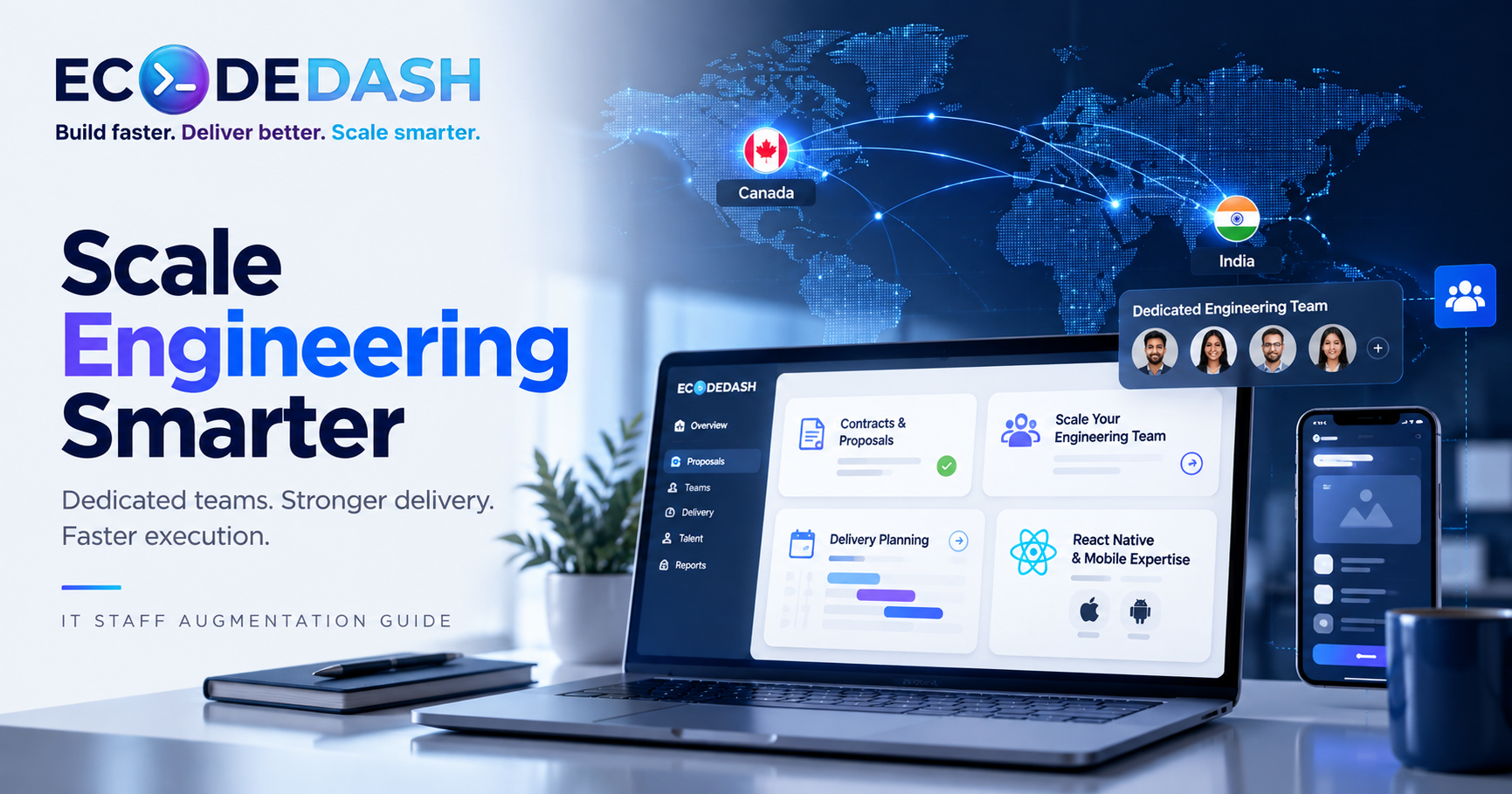
Scaling an enterprise software product in today's rapid-deployment landscape demands high agility, technical precision, and immediate access to specialized skills. Yet, engineering leaders consistently face long recruitment cycles, localized talent shortages, and escalating operational overhead when building out internal teams.
Navigating modern talent strategies requires moving beyond legacy hiring constraints. Whether you need to ramp up cross-platform mobile capabilities or bridge critical architecture gaps, leveraging expert IT staff augmentation services and dedicated development models provides a flexible, reliable pathway to hit product milestones on schedule.
Understanding IT Staff Augmentation: Definition and Core Models
When evaluating technical resourcing options, leaders often ask for a clear IT staff augmentation services definition: Staff augmentation is an agile outsourcing strategy where external, highly skilled engineers are integrated directly into an existing in-house engineering team to bridge specific talent or capacity gaps.
Unlike traditional managed services or fixed-price turnkey delivery, staff augmentation allows product leaders and engineering managers to maintain complete operational control, architectural oversight, and direct daily workflow integration.
| Engagement Dimension | IT Staff Augmentation | Dedicated Engineering Team | Traditional Fixed-Price Outsourcing |
|---|---|---|---|
| Management & Governance | Internal Engineering Leads | Hybrid (Internal Tech Lead + Vendor PM) | Vendor-Managed Delivery |
| Core Integration | Embedded in daily sprints/standups | Autonomous squad with dedicated backlog | Milestone-driven deliverables |
| Flexibility | Dynamic monthly elasticity | Medium to long-term resource planning | Rigid scope alteration process |
| Best For | Niche skill gaps, sudden spikes | Complex sub-systems, product extensions | Standardized, non-core deliverables |
Selecting between embedding individual specialists and outsourcing software development to dedicated team structures depends on your team's current management bandwidth and the architectural independence of the project.
The Core Challenges of Scaling an Engineering Team
Building out modern technical teams involves significant friction points. When organizations attempt to scale purely through local, direct full-time employee (FTE) hiring, they encounter several persistent bottlenecks:
- Extended Time-to-Fill for Specialized Stacks: Sourcing senior architects, cloud security specialists, or senior mobile engineers often takes 90 to 120 days through conventional hiring pipelines, slowing critical go-to-market roadmaps.
- High Attrition and Context Loss: High demand for senior engineers leads to unexpected turnover, forcing existing team members to spend valuable sprint cycles constantly onboarding new hires.
- Mismatched Skill Utilization: Enterprise roadmaps frequently demand temporary, deep domain knowledge—such as legacy migrations, cloud migrations, or mobile refactoring—that does not warrant permanent headcount.
- Operational and Administrative Overhead: Sourcing, background checks, compliance, hardware provisioning, and regional payroll administration consume disproportionate HR and executive focus.
By leveraging a flexible engineering extension team, product organizations can bypass multi-month sourcing funnels and deploy validated engineers within 48 to 72 hours.

Strategic Talent Hubs: India and Canada
Global engineering strategies rely heavily on geo-distributed staffing hubs that balance technical depth, time-zone alignment, and operational efficiency.
Leveraging IT Staff Augmentation Services in India
India has established itself as one of the world’s deepest talent ecosystems for enterprise software development, artificial intelligence, and mobile architectures. Engaging IT staff augmentation services in India gives global enterprises immediate access to senior developers skilled in modern frameworks, microservices, and enterprise enterprise resource planning (ERP) platforms.
Beyond sheer volume, top Indian engineering hubs provide:
- Advanced technical proficiency across modern full-stack, cloud-native, and mobile ecosystems.
- Seamless English-language communication integrated into global continuous integration/continuous deployment (CI/CD) pipelines.
- Substantial cost efficiencies that permit rapid team scaling without compromising technical rigor.
Utilizing IT Staff Augmentation Services in Canada
For North American enterprises prioritizing direct real-time workday overlap and nearshore compliance, IT staff augmentation services in Canada offer high strategic value. Canadian hubs combine top-tier technical universities, tight alignment with US business hours, and robust data privacy frameworks (such as PIPEDA and cross-border IP protections).
A hybrid strategy—combining nearshore Canadian leads for real-time collaboration with offshore Indian centers for high-throughput development—creates a robust 24-hour engineering engine.
Deep Dive: How to Hire React Native Developers Efficiently
Mobile-first experiences require performant cross-platform frameworks to avoid maintaining isolated iOS (Swift) and Android (Kotlin) codebases. React Native remains a market leader for cross-platform efficiency, but building performant mobile apps requires genuine expertise.
When evaluating how to hire React Native developers, hiring managers must assess beyond standard React web knowledge to verify true native mobile understanding.
Critical Technical Competencies to Evaluate
- Bridge & TurboModules Architecture: Understanding the legacy JavaScript bridge versus the new React Native Architecture (JSI, Fabric renderer, and TurboModules).
- Native Module Integration: Proven ability to write custom native bridges in Objective-C/Swift for iOS and Java/Kotlin for Android when third-party libraries fall short.
- Performance Profiling & Memory Management: Proficiency with Flipper, React Native Debugger, Android Studio Profiler, and Xcode Instruments to troubleshoot frame drops and memory leaks.
- State Management & Offline Storage: Experience with Redux Toolkit, Zustand, WatermelonDB, or SQLite for resilient offline-first mobile operations.
Tactical Framework to Hire React Native App Developers in India
When looking to hire React Native app developers in India, implement a streamlined evaluation pipeline:
[Stage 1: Portfolio & Architecture Audit]
         │
         ▼
[Stage 2: Live Code Refactoring / Native Bridge Exercise]
         │
         ▼
[Stage 3: Deep System Design & State Architecture Check]
         │
         ▼
[Stage 4: Culture, Async Communication & 48-Hour Onboarding]- Screen App Store Footprints: Inspect live production applications built by the candidate on Google Play and Apple App Store to assess UI fluidity, load times, and gesture handling.
- Run Real-Time Profiling Exercises: Provide an unoptimized sample component and ask the candidate to identify unnecessary re-renders, slow JS thread operations, and bundle size bloat.
- Assess Cross-Platform Parity Skills: Ensure the developer understands platform-specific Human Interface Guidelines (Apple HIG vs. Google Material Design).
Navigating Contracts, Proposals, and Presentations
Executive alignment requires diligence throughout procurement, legal structuring, and stakeholder reviews. Securing buy-in and establishing accountability depends on well-structured contracts, proposals, and presentations.
Structuring the IT Staff Augmentation Services Contract
A robust IT staff augmentation services contract safeguards intellectual property, outlines liability boundaries, and guarantees service continuity. When drafting or negotiating legal terms, focus on these critical clauses:
- Master Services Agreement (MSA): Governs overarching commercial terms, confidentiality, dispute resolution, and non-solicitation parameters.
- Statement of Work (SOW): Explicitly specifies the required roles, tech stacks, seniority tiers, billing rates, and expected weekly commitments.
- Intellectual Property (IP) Transfer: Complete, immediate assignment of all code, documentation, and technical artifacts created during the engagement to your enterprise.
- Service Level Agreements (SLAs) & Replacement Warranties: Clear stipulations requiring the vendor to replace any underperforming developer within 5–10 business days without additional onboarding costs.
- Data Protection & Compliance: Strict protocols for data handling, VPN/VDI access, and compliance certifications (SOC 2, ISO 27001, GDPR).
Reviewing the IT Staff Augmentation Services Proposal
A high-quality IT staff augmentation services proposal should go beyond vague talent claims. High-yield proposals provide:
- Detailed developer skill matrices, including verified production achievements and previous project architectures.
- Clear hourly or monthly blended rate cards with zero hidden administrative fees.
- Defined talent replacement mechanisms and ramp-up lead times.
- Clear time-zone overlap schedules ensuring a minimum of 4–6 hours of direct collaboration daily.
Building the Internal IT Staff Augmentation Services Presentation
When presenting the business case to senior leadership (CTO, VP of Engineering, or CFO), design your IT staff augmentation services presentation around risk reduction, milestone velocity, and measurable financial ROI:
- Cost of Inaction vs. Accelerated Velocity: Quantify the revenue impact of delayed product launches versus rapid augmentation.
- Total Cost of Engagement Comparison: Contrast total FTE costs (recruiting fees, equity, benefits, hardware, retention incentives) against all-inclusive augmentation rates.
- Governance & Architectural Integrity: Reassure stakeholders that core code reviews, architecture choices, and release triggers remain under internal control.
Scaling Successfully with Dedicated Team Software Development
When your product initiatives require more than individual capacity additions—such as building an autonomous mobile platform, modernizing legacy enterprise systems, or developing specialized microservices—dedicated team software development delivers the highest long-term leverage.
┌────────────────────────────────────────────────────────┐
│               Your Internal Leadership                 │
│         (VP Engineering / Principal Architect)         │
└───────────────────────────┬────────────────────────────┘
                            │ Direct Strategic Direction
                            ▼
┌────────────────────────────────────────────────────────┐
│         Dedicated Squad (Augmented Extension)          │
│  ┌───────────────┐ ┌───────────────┐ ┌──────────────┐  │
│  │ Senior Mobile │ │ Cloud/DevOps  │ │ QA / Test    │  │
│  │ Engineers     │ │ Specialists   │ │ Automation   │  │
│  └───────────────┘ └───────────────┘ └──────────────┘  │
└────────────────────────────────────────────────────────┘
By uniting specialized developers, DevOps specialists, and QA automation engineers into a synchronized extension of your organization, dedicated teams eliminate operational drag and deliver continuous velocity.

Best Practices for Seamless Developer Integration
- Standardize Local Setup Scripts: Provide containerized development environments (Docker Dev Containers) so external engineers can spin up codebases on day one.
- Establish Transparent Async Communication: Use centralized tools (Slack, Jira, Linear, GitHub) with clear PR review guidelines, automated testing thresholds, and sprint rituals.
- Measure Real Engineering Metrics: Track DORA metrics (Deployment Frequency, Lead Time for Changes, Change Failure Rate, Time to Restore Service) to ensure steady productivity gains.
Accelerate Your Engineering Roadmap with Ecode Dash
Scaling an engineering team does not require lengthy recruitment timelines or compromises on code quality. Whether you need senior React Native developers to revamp your mobile platform or a dedicated engineering pod to accelerate delivery, choosing the right partner transforms technical capacity from a bottleneck into a competitive advantage.
Ready to scale with pre-vetted, top 5% engineering talent integrated in under 48 hours? Take the next step to explore Ecode Dash's vetted talent network and unlock high-velocity development today.