Ecode Dash Blog
IT Staff Augmentation Services: The Definitive Enterprise Playbook and Regional Sourcing Guide
Master enterprise IT staff augmentation with our comprehensive guide covering global delivery models, regional hubs, procurement guidelines, and modern PMBOK frameworks.
By Ecode Dash Editorial Team · Software Engineering & Technology Consulting
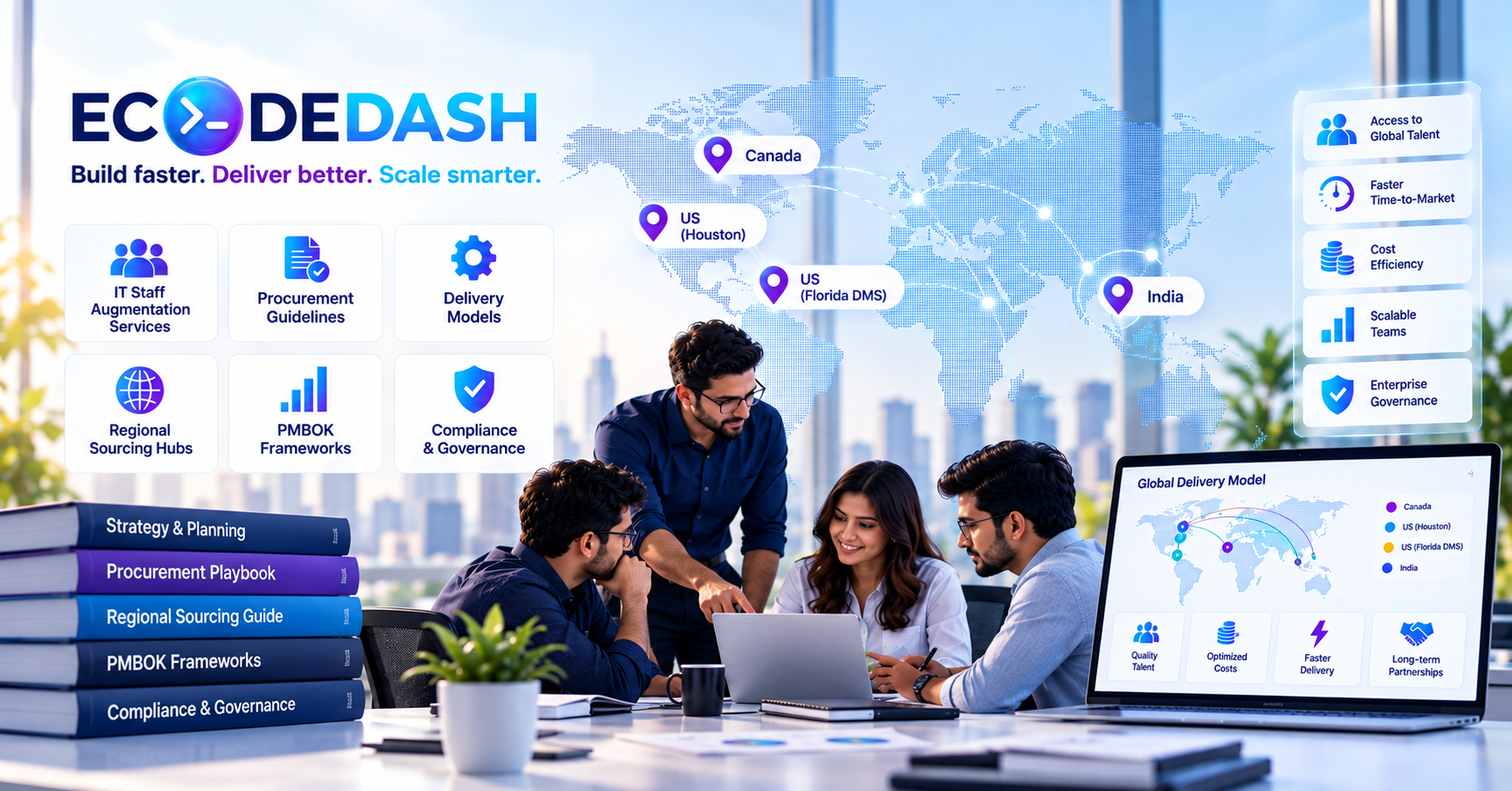
In an era of hyper-accelerated product cycles, AI adoption, and sudden skill shortages, engineering leaders face an unyielding mandate: ship mission-critical software faster without inflating permanent payroll. Traditional hiring cycles—often stretching between 60 to 90 days per senior engineer—create massive bottlenecks that stall digital roadmaps. Consequently, modern technology organizations rely on strategic staff augmentation to bridge technical deficits on demand.
Navigating IT staff augmentation services requires a firm grasp of procurement guidelines, global resource distribution, contract governance, and evolving project management standards. This comprehensive guide outlines the operational frameworks, regional sourcing hubs, and contractual best practices necessary to scale your engineering velocity with precision.
The Evolution of IT Staff Augmentation: From Legacy Contracting to Agile Extension
IT resource management has undergone massive structural changes over the past decade. Historically, external hiring was viewed primarily as transactional body shopping—filling seats to perform routine maintenance or manual testing.
Traditional Contracting (Pre-2020)       Modern Agile Augmentation (2026+)
┌───────────────────────────────┐        ┌───────────────────────────────┐
│ • Generalized skill matching   │        │ • AI-vetted domain specialists│
│ • Months-long procurement     │   ───► │ • 48-hour team integration    │
│ • Transactional task handoff  │        │ • Deep cultural/SDLC cohesion │
│ • Geographic silos            │        │ • Global distributed workflows│
└───────────────────────────────┘        └───────────────────────────────┘
The Post-2020 Remote-First Paradigm Shift
When global business conditions changed dramatically in 2020, remote collaboration tools and asynchronous workflows matured almost overnight. The legacy model of requiring on-premise contractors dissolved. Enterprises realized that geographical proximity mattered far less than domain expertise, code quality, and timezone alignment. Modern resource augmentation now functions as a direct extension of core engineering units, seamlessly integrating into internal sprint planning, continuous deployment pipelines, and code review rituals.
Alignment with Modern Project Management Standards
The theoretical foundations of resource acquisition and procurement management have evolved alongside software delivery methodologies:
- PMBOK Guide 5th Edition Baseline: Emphasized rigid, plan-driven procurement, strict contract boundary definitions, and linear vendor management processes.
- PMBOK Guide 6th Edition Transition: Introduced greater adaptability, emphasizing hybrid methodologies and acknowledging agile contracting models.
- PMBOK Guide 7th Edition Performance Domains: As detailed throughout the official PMBOK 7th edition PDF documentation and standard artifacts, modern frameworks shifted focus entirely from rigid processes to value-driven delivery, team performance domains, and flexible resource scalability.
Modern engineering leaders leverage these updated performance principles to build high-trust, outcome-oriented staff extension engagements rather than relying on outdated, milestone-bound administrative red tape.
Regional Sourcing Ecosystems: Hubs, Rates, and Regulatory Landscapes
Choosing the right sourcing destination involves balancing cost efficiency, technical complexity, timezone overlap, and regional compliance standards.
| Sourcing Region / Hub | Primary Focus & Stack Strengths | Cost Structure | Core Strategic Advantage |
|---|---|---|---|
| United States (Houston, TX) | EnergyTech, Industrial IoT, Enterprise SAP, HealthTech | Premium ($110–$180+/hr) | Zero timezone friction, deep vertical domain knowledge |
| United States (Florida) | FinTech, GovTech, Logistics, Cloud Migration | Premium ($100–$165+/hr) | Established state procurement frameworks (DMS compliance) |
| Canada (Toronto, Vancouver) | AI/ML Research, FinTech, Full-Stack SaaS | Mid-High ($85–$140/hr) | Direct North American cultural and time alignment with SR&ED tax incentives |
| India (Bangalore, Hyderabad) | Cloud/DevOps, AI/ML, Full-Stack, QA Automation | Highly Competitive ($30–$65/hr) | Massive technical talent pool, 24/7 follow-the-sun development capabilities |
| Emerging Asia (Gov.lk / SL Ecosystem) | Core Web, Enterprise Mobile, Quality Engineering | Highly Competitive ($25–$50/hr) | Strong engineering literacy and agile public/private tech initiatives |
North American Innovation Hubs: Houston, Florida, and Canada
- Houston, Texas Services: As an industrial and medical powerhouse, the demand for IT staff augmentation in Houston centers heavily around operational technology (OT/IT) convergence, SAP S/4HANA migrations, SCADA systems, and high-compliance healthcare platforms.
- Florida State Procurement Standards: In regional enterprise and public sector initiatives, adherence to Florida Department of Management Services (DMS) procurement guidelines and pre-negotiated state term contracts sets the standard for vendor vetting, background clearance, and SLA governance.
- The Canadian Corridor: Offering strong engineering universities and favorable immigration pathways for top global tech talent, Canadian hubs provide an ideal nearshore alternative for US-based engineering directors seeking high overlap with Pacific and Eastern working hours.
Global Scale: India and Offshore Talent Networks
India remains the global nucleus for scalable engineering capacity. Beyond legacy cost arbitrage, top-tier engineering partners in India provide specialized expertise in generative AI implementation, MLOps, cloud infrastructure architecture, and complex enterprise backends. Structured overlap windows ensure synchronous agile ceremonies while offshore hours unlock continuous integration and automated test cycles.
Comprehensive IT Staff Augmentation Guidelines and Governance
Executing a smooth staff augmentation initiative requires structured governance across the entire engagement lifecycle. Following established operational guidelines prevents scope drift, intellectual property risks, and team friction.
┌─────────────────┐     ┌──────────────────┐     ┌──────────────────┐     ┌─────────────────┐
│  1. Diagnostic  │ ───► │  2. Procurement  │ ───► │  3. Onboarding   │ ───► │ 4. Performance  │
│  Skill Mapping  │     │   & Legal Gate   │     │   & Tool Setup   │     │   Optimization  │
└─────────────────┘     └──────────────────┘     └──────────────────┘     └─────────────────┘
1. Architectural Skill Mapping
Before initiating outreach, engineering leadership must clearly distinguish between a missing competency (e.g., Kubernetes orchestration or Flutter expertise) and a missing capacity (e.g., needing three additional React developers to hit a product milestone). Clear role scoping prevents misaligned staffing.
2. Legal, IP, and Compliance Infrastructure
Every enterprise engagement must be governed by ironclad agreements:
- Master Services Agreement (MSA): Defines overall commercial terms, indemnification, warranty periods, and non-solicitation clauses.
- Statement of Work (SOW): Details specific tech stacks, billing mechanisms (Time & Materials vs. Dedicated Capacity), and performance milestones.
- IP Assignment and Data Security: Ensures that 100% of code, architecture diagrams, and documentation produced remain the exclusive intellectual property of your enterprise from the moment of creation.
3. Rapid Tooling and Repository Onboarding
High-performing engineering teams maintain structured onboarding checklists. Vetted engineers should receive identity-verified single sign-on (SSO) credentials, ephemeral development environment access, and repository permissions within the first 24 to 48 hours of deployment.
Actionable Procurement Templates and Operational Artifacts
Standardizing your internal intake and vendor communication streamlines procurement cycles and ensures technical alignment from day one.
1. Enterprise Resource Request Form
Use this standardized form format when internal engineering teams request external talent allocation:
### Engineering Staff Augmentation Request Form
* **Requesting Department / Pod:** [e.g., Core Payments Engineering]
* **Target Start Date & Duration:** [e.g., Nov 1 | 6 Months Initial Retainer]
* **Role Title & Seniority Level:** [e.g., Senior Full-Stack Engineer (L5 Equivalent)]
* **Required Core Tech Stack:** [e.g., Node.js, TypeScript, PostgreSQL, AWS Lambda]
* **Secondary / Nice-to-Have Skills:** [e.g., Terraform, GraphQL, Redis]
* **Timezone Overlap Requirement:** [e.g., Minimum 4 hours EST synchronous overlap]
* **Primary Success Metric / Deliverable:** [e.g., Refactoring payment gateway microservice to achieve sub-200ms latency]
* **Budget Code & Approval Authority:** [e.g., ENG-CAPEX-2026-Q4]
2. Vendor Outreach and RFP Initial Email Template
When contacting staffing partners or issuing requests for technical talent profiles, structured communication eliminates back-and-forth ambiguity:
Subject: Request for Technical Profiles: [Role Title] - [Company Name]

Dear [Partner Name / Account Executive],

Our engineering organization is currently expanding capacity within our [Product Pod] and seeking [Number] senior [Role Title(s)] on a dedicated staff augmentation basis.

Key Requirements:
- Tech Stack: [List core languages, frameworks, and databases]
- Experience Level: [e.g., 5+ years building distributed enterprise applications]
- Engagement Model: [Full-time dedicated / 40 hours per week / 6-month initial SOW]
- Timezone Coverage: [Required working hours / overlap window]
- Start Date: [Immediate / within 1–2 weeks]

Please provide:
1. 2–3 anonymized, pre-vetted candidate profiles/resumes matching this exact stack.
2. Standard hourly / monthly rate cards under a Time & Materials structure.
3. Confirmation of vetting depth (technical live coding, architectural interview, background checks).

We look forward to receiving your candidate submissions by [Date].

Best regards,
[Your Name]
[Your Title]
[Company Name]
Evaluating Engagement Models: Staff Augmentation vs. Dedicated Teams vs. Managed Services
Selecting the right model depends on where architectural ownership and delivery responsibility should reside.
                  Direct Internal Control ◄──────────────────────────────► Vendor Managed Output
┌────────────────────────────────────────┬───────────────────────────────────────┐
│         Staff Augmentation             │           Managed Services            │
│ • Internal team leads direct daily tasks│ • Vendor owns end-to-end delivery     │
│ • Maximum flexibility to shift priorities│ • Fixed deliverables and SLA focus   │
│ • Lowest onboarding overhead           │ • Higher total contract commitment    │
└────────────────────────────────────────┴───────────────────────────────────────┘- Staff Augmentation (Engineering Extension): Ideal when you have capable internal engineering managers and a clear architectural vision, but lack bandwidth or specific niche skills. Developers integrate into your Jira boards and daily standups.
- Dedicated Extension Pods: Autonomous units (e.g., 1 Lead Architect + 3 Developers + 1 QA) managed collaboratively to own a complete feature vertical.
- End-to-End Product Outsourcing: Suited for non-core internal tools or standalone applications where internal teams prefer to hand off complete specification and delivery ownership.
Maximizing ROI: How to Successfully Sell Staff Augmentation Internally
Securing budget approval from CFOs and executive leadership requires framing staff augmentation not as an operational expense, but as a strategic risk mitigation and capital efficiency lever.
- Demonstrate Speed-to-Market Gains: Quantify the opportunity cost of an open engineering req. If a core product feature delayed by three months represents $200,000 in unrealized revenue, bringing on vetted talent within 48 hours immediately pays for itself.
- Highlight Total Cost of Workforce Savings: Full-time employee (FTE) compensation packages carry extensive overhead—health benefits, 401(k) matching, equity vesting, recruitment agency fees (often 20–25% of first-year base), hardware procurement, and long-term severance risks. Flexible augmentation models convert these fixed liabilities into elastic operational expenses.
- De-Risk Technical Spikes: Specialized initiatives—such as zero-downtime database migrations, HIPAA compliance hardening, or bespoke AI model fine-tuning—rarely justify a permanent full-time salary. Augmenting with specialized experts ensures rapid execution without long-term organizational bloat.
Accelerate Your Engineering Velocity with Pre-Vetted Talent
Building high-performance software requires world-class engineers who hit the ground running. When you need to scale up without the friction of multi-month hiring cycles, partner with a team that vets for elite problem-solving, architectural mastery, and seamless communication.
Explore how a flexible engineering extension team can help you deploy pre-vetted AI, Cloud, Full-Stack, and Enterprise engineers directly into your sprint cycles within 48 hours.