Ecode Dash Blog
What a Performance Testing Engineer Does Before Black Friday 2026
Black Friday falls on 27 November 2026, so e-commerce and SaaS teams have weeks to prove checkout and APIs can hold peak demand. This guide explains what a performance testing engineer does in that window, how to sequence load, stress and rollback work, and how hourly or project-based staff augmentation fits a fixed deadline.
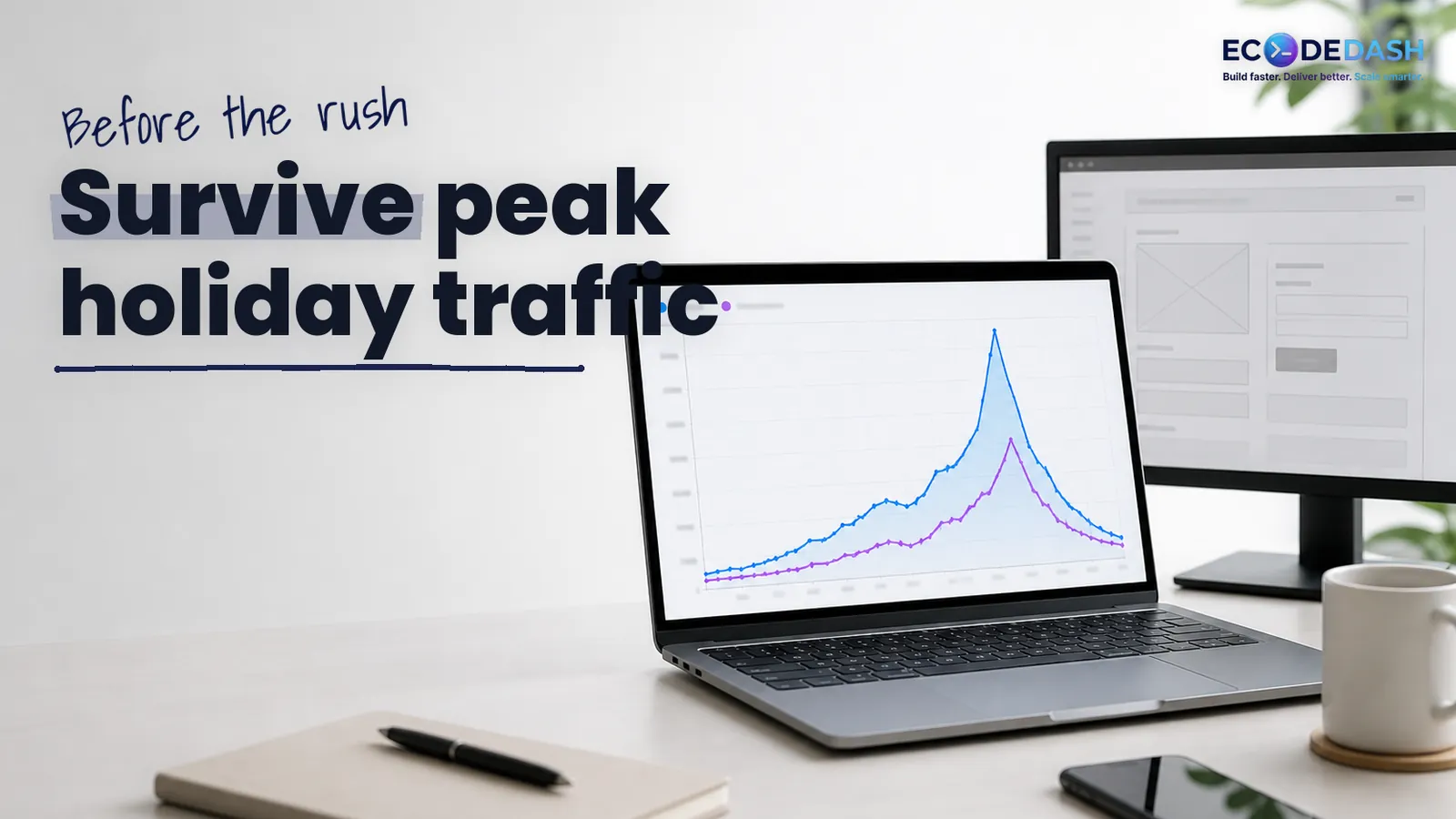
Black Friday falls on 27 November 2026, and most e-commerce and SaaS teams have fewer than three weeks to prove that checkout, login and core APIs will survive peak demand. The specialist who does that work is a performance testing engineer, and many in-house teams lack one at exactly the moment the calendar demands it.
This guide explains what that engineer does in the final weeks, how to sequence the work around a fixed code freeze, and how short-term IT staff augmentation closes the gap.
Key takeaways
- Performance specialists test capacity, not features. The core work is load, stress and spike testing on checkout and APIs, followed by bottleneck analysis.
- Autoscaling and rollback must be rehearsed under real load. Reading configuration files does not prove they work.
- With limited time, order the work as baselines first, fixes second and rehearsals last, all before code freeze.
- Hourly or project-based staff augmentation can add a vetted specialist quickly. EcodeDash states that it shares candidate profiles within 48 hours.
At a glance
- Event date: Black Friday, 27 November 2026
- Core work: load, stress and spike tests, bottleneck analysis, autoscaling checks, rollback rehearsals
- Engagement models: hourly, project-based or long-term retainer
- Time to first profiles: within 48 hours, according to EcodeDash
- Where to start: the Performance Testing Engineer role on the EcodeDash Hire by Stack page
What does a performance testing engineer do before Black Friday?
A performance testing engineer simulates realistic peak traffic against your checkout flows and APIs, then measures how response times and error rates change as load rises. The engineer identifies the component that fails first and confirms that autoscaling and rollback behave correctly under pressure. The output is evidence your team can act on before code freeze.
A QA automation engineer verifies that features behave correctly. A performance specialist verifies how the system behaves when thousands of sessions arrive at once. In the last weeks before a peak event, that work breaks into five jobs.
Load testing checkout and payment flows
Load testing runs the system at its expected peak concurrency (the number of users or requests active at the same moment) for a sustained period. Checkout is a chain of dependent steps: cart updates, inventory reservation, tax calculation, the payment gateway and order confirmation. Each link can fail in its own way.
The engineer scripts realistic user journeys in tools such as k6, Apache JMeter, Gatling or Locust. Good scripts include think time between actions and a believable mix of browsing and buying. The key measures are p95 latency (the response time that 95 percent of requests beat), error rate and throughput.
Stress and spike testing APIs
A stress test pushes load beyond the expected peak until something breaks, so the team learns where its ceiling sits. A spike test simulates a sudden jump, such as a midnight promotion or a campaign email reaching a large list at once.
SaaS platforms that sit behind retailers feel this acutely. Search, pricing, loyalty and recommendation APIs receive spikes from every customer at the same moment, so shared services need their own tests.
Finding bottlenecks
A bottleneck is the single component that limits throughput for the whole system. Common culprits include exhausted database connection pools, unindexed queries, lock contention on popular inventory rows, cache stampedes (many requests rebuilding the same expired cache entry simultaneously) and synchronous calls to third-party services.
The engineer correlates load test results with application performance monitoring (APM) traces and infrastructure metrics. That correlation locates the real constraint, which is often not the component the team suspected.
Validating autoscaling
Autoscaling adds compute capacity automatically when a metric such as CPU or request rate crosses a threshold. The practical questions are about timing and dependencies:
- How long does a new instance or pod take to start serving traffic?
- Do thresholds trigger early enough, or does scaling begin after users already see errors?
- Can the database and cache tiers keep up when the application tier scales out?
- Are cloud account quotas high enough for the peak instance count?
Rehearsing rollback
A rollback rehearsal deploys a release under load, reverts it and times the whole process. The same session should test feature flags that switch off heavy, non-essential features such as live recommendations. This is called graceful degradation: checkout keeps working while the extras pause.
Run the rehearsal with the people who will actually be on call, because the runbook is only as good as the person following it at 2 a.m.
How should you plan load testing before Black Friday 2026?
Work backward from your code freeze. Spend the first days on baselines and targets, the middle days on fixes and retesting, and the final days on stress, spike, autoscaling and rollback rehearsals. Load testing before Black Friday only pays off if the fixes it uncovers have time to ship.
A practical sequence looks like this:
- Set targets. Start from your own peak data from last season and adjust for growth and campaign plans. Define pass thresholds for p95 latency and error rate before the first test runs.
- Build a production-like environment. Match instance sizes, database configuration and data volume as closely as budget allows. Tests against a half-sized staging stack produce numbers you cannot trust.
- Capture baselines. Run each critical journey at normal load and record results. These numbers make every later change measurable.
- Run load tests, then fix. Test at expected peak, analyse the slowest traces and ship the highest-impact fixes first. Retest after each change.
- Run stress and spike tests. Find the ceiling and observe recovery behaviour once load drops.
- Rehearse autoscaling and rollback. Do this late, after fixes have landed, so the rehearsal reflects the code you will actually run.
- Freeze and monitor. Agree alert thresholds, an on-call rota and a decision owner for rollback calls.
As a hypothetical example, imagine a retailer whose checkout slows sharply under test. The traces show that every order locks the same inventory row, so concurrent buyers queue behind one another. The fix is a change to how stock is reserved, and the retest confirms it. This is an illustration of the method, not a measured result.

What skills should a performance testing engineer have?
A strong performance testing engineer combines scripting ability, systems knowledge and clear communication. Typical performance testing engineer skills include writing load scripts, reading APM traces, understanding databases and caches, and working with cloud autoscaling and container platforms such as Kubernetes. Reporting findings in plain language matters as much as the tooling.
If you are drafting a job description or interview questions, test for judgement as well as tools. Ask candidates how they would design a realistic checkout scenario, how they would decide whether a test environment is trustworthy, and how they would separate an application bottleneck from a network or database one. Candidates who answer with specific past incidents usually have real peak-season experience.
Seniority also shapes cost. Rates for a performance test engineer vary by experience and region, and this article does not quote figures. That variability is one reason hourly or project-based billing suits a short engagement better than a permanent salary commitment.
Should you hire a performance tester for a few weeks?
Yes, when the workload is concentrated, the deadline is fixed and your engineers are already committed to feature delivery. A short-term specialist brings tested scripts, tool fluency and a fresh view of your architecture. Permanent hiring takes months, which is longer than the time you have.
When you hire a performance tester for a defined project, the scope should be narrow and measurable. Good deliverables include load test scripts, a ranked bottleneck report, autoscaling findings and a documented rollback rehearsal. Your own team keeps ownership of the fixes, while the specialist keeps the evidence flowing.

How does IT staff augmentation fit a Black Friday deadline?
IT staff augmentation adds an external specialist to your team for a defined period, on an hourly or project basis, without a permanent hire. EcodeDash states that it provides pre-vetted engineers who can integrate within 48 hours and that profiles typically arrive within that window.
According to EcodeDash, only the top 5 percent of candidates pass its four-stage process, which covers requirement discovery, AI-powered curation, multi-stage vetting and onboarding (EcodeDash Hire by Stack, 2026). The company lists Performance Testing Engineer among its roles and says it serves clients across India, Singapore, Europe and the UAE with timezone alignment. For teams hiring in tech hubs such as Bangalore or Hyderabad, or supporting them from abroad, that overlap helps during a compressed schedule.
Receive profiles within 48 hours, hire seamlessly, and scale with ongoing support. (EcodeDash, 2026)
Share on LinkedIn · Share on X
The Hire by Stack page is the quickest way to brief the right specialist, because it lists QA, cloud and DevOps roles side by side. A performance specialist often works best alongside a site reliability or cloud engineer.
What to check before you sign
Whether the vendor is an IT staff augmentation services LLC or a larger firm, a few contract points deserve attention under deadline pressure:
- Notice terms: Confirm the IT staff augmentation services notice period so you can extend or end the engagement quickly.
- Accountable contact: Ask for a named IT staff augmentation services officer, meaning one person responsible for delivery and escalation.
- Replacement policy: EcodeDash says it replaces developers who do not meet expectations without extra cost. Get any such terms in writing.
- Access and security: Agree environment access, data handling and monitoring permissions before day one.
What this means for you
If you lead engineering at an e-commerce or SaaS company, the decision comes down to four questions. Do you know your peak checkout and API load targets? Do you have a production-like test environment? Has anyone on your team run a rollback rehearsal under load? Is that person free for the next three weeks?
If any answer is no, treat the gap as a risk to close now, not after code freeze. Define a narrow scope, brief a specialist and give them access on day one. Then protect the final days for rehearsals, because that is when confidence is built.
Conclusion
The weeks before Black Friday reward teams that test early, fix what they find and rehearse their recovery plan. A performance testing engineer provides the method and the evidence, and short-term staff augmentation makes that expertise available on a schedule your calendar can support.
If your team needs that capacity quickly, explore the EcodeDash engineering extension team and share your stack and timeline to receive profiles within 48 hours.
Frequently asked questions
How long before Black Friday should load testing start?
Start as early as your release schedule allows, because fixes found in testing need time to ship and be retested. If you are already inside three weeks, run baseline tests immediately and reserve the final days for rollback rehearsals, not new discovery work.
What is the difference between load testing and stress testing?
Load testing runs the system at its expected peak to confirm it meets targets. Stress testing pushes past that peak until something fails, so you learn where the ceiling is and how the system recovers.
Can a short-term hire really help in under three weeks?
Yes, if the scope is narrow and your team can give access to environments and monitoring on day one. A specialist who has run peak-season tests before usually spends the first days building scripts and baselines, then moves quickly into bottleneck analysis.
Do I need to test my payment provider during a load test?
Usually not. Replace the live payment gateway with a stub or sandbox endpoint unless the provider has agreed to the test in writing, because uninvited traffic can trigger fraud controls or breach terms of service.
What should an hourly or project-based engagement include?
Define the deliverables up front: test scripts, a bottleneck report, autoscaling findings and a rollback rehearsal log. Agree the notice period and a single accountable contact so the engagement can be adjusted quickly if scope changes.
Related resource
Performance Engineering · IT Staff Augmentation · performance testing engineer · load testing before black friday · hire performance tester · it staff augmentation services llc · it staff augmentation services notice · it staff augmentation services officer