Ecode Dash Blog
Scaling Enterprise ERP Migrations: SAP ABAP, Fiori UI5, and Cross-Platform Mobile Extensions
A strategic enterprise guide to scaling SAP S/4HANA migrations, refactoring custom ABAP code, deploying SAP Fiori UI5 interfaces, and augmenting cross-platform mobile teams.
By Ecode Dash Editorial Team · Software Engineering & Technology Consulting
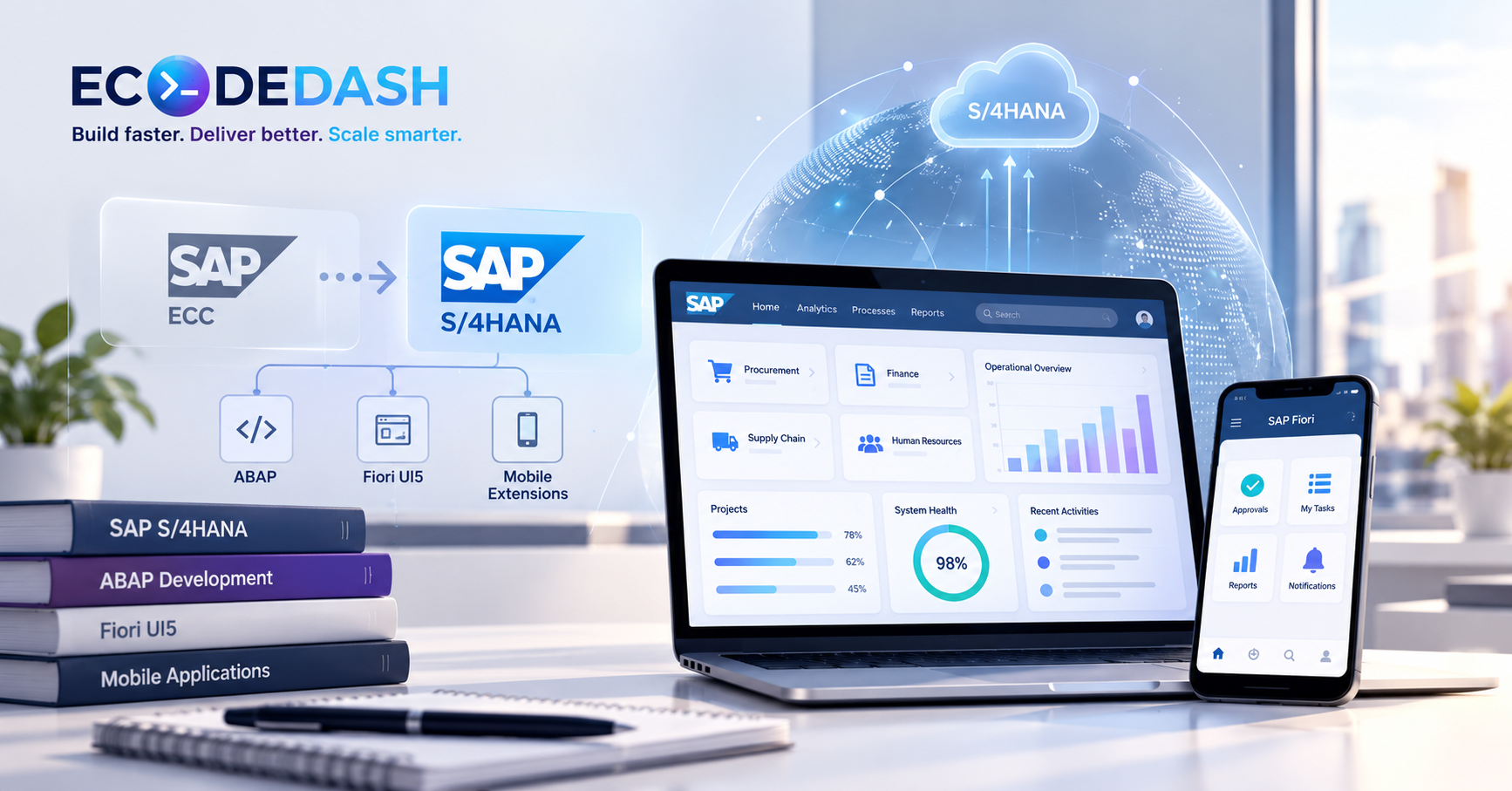
Modern enterprise resource planning (ERP) systems represent the foundational central nervous system of global business operations. However, enterprise IT leaders are facing an unprecedented operational bottleneck: the mandatory transition to next-generation platforms like SAP S/4HANA, the imperative to modernize legacy enterprise codebases, and the mounting user demand for intuitive mobile interfaces across warehouse, supply chain, and executive operations.
Completing these multi-million-dollar digital transformations requires far more than legacy system maintenance. It demands a dual-track engineering paradigm: deep-core enterprise refactoring using advanced SAP ABAP and SAP Fiori UI5 alongside agile, modern client-facing applications built on cross-platform frameworks. Achieving this velocity without inflating fixed overhead requires IT leaders to rethink resource allocation, blending internal domain experts with specialized external talent models.
The Architecture of Next-Generation ERP Migrations
Enterprise organizations migrating from legacy SAP ECC 6.0 to SAP S/4HANA confront significant architectural shifts. The traditional approach of embedding bespoke business logic directly into transaction databases has been superseded by the "Clean Core" philosophy. In this updated paradigm, core business records remain standard and upgradeable, while custom workflows, business logic, and client interfaces run on decoupled application layers.
+-------------------------------------------------------------------------+
|                        Enterprise Client Layer                          |
|  +---------------------------+       +-------------------------------+  |
|  |   SAP Fiori Launchpad     |       | Cross-Platform Mobile Apps    |  |
|  |      (SAPUI5 / OData)     |       | (React Native / Offline Sync) |  |
|  +-------------+-------------+       +---------------+---------------+  |
+----------------|-------------------------------------|------------------+
                 |                                     |
                 +------------------+------------------+
                                    |
                                    v
+-------------------------------------------------------------------------+
|                    Integration & API Gateway Layer                      |
|  +-------------------------------------------------------------------+  |
|  |     SAP BTP / RESTful Application Programming Model (RAP) / CAP   |  |
|  +-------------------------------------------------------------------+  |
+-----------------------------------|-------------------------------------+
                                    |
                                    v
+-------------------------------------------------------------------------+
|                        Core Digital Foundation                          |
|  +-------------------------------------------------------------------+  |
|  |        SAP S/4HANA Core (ABAP Cloud / Core Data Services - CDS)   |  |
|  +-------------------------------------------------------------------+  |
+-------------------------------------------------------------------------+
To execute this modernization pattern without disrupting revenue-generating operations, organizations must coordinate three specialized skill disciplines:
- Advanced ABAP Refactoring: Converting legacy procedural ABAP and direct table queries to object-oriented ABAP, Core Data Services (CDS) views, and the ABAP RESTful Application Programming (RAP) model.
- SAP Fiori UI5 Web Development: Designing responsive, role-based, coherent SAPUI5 web components integrated with SAP Business Technology Platform (BTP).
- Decoupled Mobile Frontends: Building secure, offline-capable mobile client apps using lightweight JavaScript frameworks connected via OData and REST APIs to provide edge workers with real-time operational data.
Modernizing the Backend: SAP ABAP on HANA and Clean Core Compliance
Decades of legacy ERP customizations often leave enterprises with technical debt: unindexed custom tables, deprecated function modules, and non-performant batch jobs. Transitioning to SAP HANA’s in-memory database architecture requires refactoring custom code to leverage "code pushdown" techniques.
Code Pushdown and Core Data Services (CDS)
Rather than extracting vast datasets into the application layer for iterative processing, modern ABAP pushes data-intensive aggregations, calculations, and joins directly into the HANA database layer. Senior ABAP specialists achieve this using Core Data Services:
@AbapCatalog.sqlViewName: 'Z_V_SALES_AGG'
@AbapCatalog.compiler.compareFilter: true
@AccessControl.authorizationCheck: #CHECK
@EndUserText.label: 'Aggregated Sales Analytics by Region'
define view Z_C_SalesAnalytics
  as select from zsales_order as OrderHeader
  association [0..*] to zsales_item as _Items
    on $projection.order_id = _Items.order_id
{
  key OrderHeader.order_id,
      OrderHeader.customer_id,
      OrderHeader.region,
      @Semantics.amount.currencyCode: 'currency'
      sum(_Items.net_amount) as total_regional_amount,
      OrderHeader.currency
}
group by OrderHeader.order_id, OrderHeader.customer_id, OrderHeader.region, OrderHeader.currency;
Deploying these optimized CDS views decreases payload latency across network layers, enabling front-end web and mobile applications to display enterprise analytics instantaneously.
Unifying User Experience: SAP Fiori UI5 and Cross-Platform Mobile Extensions
While SAP Fiori UI5 delivers a standardized desktop interface across the enterprise back-office, field operators, inventory managers, and supply chain logistics staff frequently require purpose-built mobile applications capable of hardware scanning, offline data queuing, and fluid cross-platform performance.

Why Enterprises Combine SAP Fiori with Dedicated Mobile Frameworks
Enterprise mobility cannot be treated as an afterthought. Frontline workers in remote distribution hubs often operate in low-connectivity environments where full browser-based Fiori apps might experience connectivity dropouts. Integrating dedicated mobile solutions built with React Native bridges this operational divide.
Key architectural benefits include:
- Single Codebase for iOS and Android: Reducing total lifecycle maintenance and UI synchronization costs across heterogeneous mobile fleets.
- Robust Offline-First SQLite Synchronization: Enabling warehouse scanning and order reconciliation to persist locally before synchronizing back via OData services.
- Biometric and Peripheral Hardware Access: Native device integration for RFID handhelds, thermal barcode printers, and secure hardware keystores.
When scaling these initiatives, enterprises routinely search to hire react native app developers who possess both frontend client mastery and experience consuming enterprise REST/OData endpoints. For specialized high-performance mobile units, engaging flexible engineering extension teams ensures that mobile engineers and SAP backend architects collaborate seamlessly under shared API governance models.
The Resourcing Dilemma: In-House Recruiting, Traditional System Integrators, or Dedicated Engineering Augmentation?
Executing complex ERP transformations while expanding mobile access creates intense talent competition. Engineering leaders must evaluate three primary resourcing pathways:
| Evaluation Metric | Full-Time In-House Hiring | Traditional Big-4 System Integrators | Dedicated Engineering Augmentation |
|---|---|---|---|
| Time-to-Deploy | 3 to 6 months per role | 4 to 8 weeks for contract setup | 48 to 72 hours for pre-vetted engineers |
| Direct Control & Governance | 100% direct management | Low direct control; opaque subcontractor layers | Complete direct architectural and daily sprint control |
| Cost Structure | High fixed overhead, benefits, retention load | Extreme blended billing rates ($200–$350+/hr) | Cost-effective, transparent direct developer rates |
| Scalability Flexibility | Rigid; difficult to scale down post-migration | Strict scope statements and change-order fees | Fluid elasticity; scale up or down per sprint cycle |
| Skill Modernity | Variable; requires continuous internal training | Variable talent quality depending on bench availability | Pre-screened top 5% talent in specific tech stacks |
For most CTOs, CIOs, and Enterprise Program Managers, assembling a dedicated team for software development offers the ideal balance between strategic flexibility and high-output velocity.
Strategic Talent Sourcing: Balancing Onshore Oversight with Global Engineering Scale
To optimize budget allocation while maintaining rapid delivery cycles, forward-thinking enterprises use hybrid engineering models. Sourcing it staff augmentation services in usa provides high-touch technical leadership, solution architecture, and compliance oversight during domestic business hours. Simultaneously, partnering with global engineering hubs allows organizations to unlock continuous 24-hour engineering pipelines.
Leveraging Global Engineering Hubs for Enterprise Mobile Acceleration
When expanding mobile ERP capabilities, global sourcing models offer significant leverage. Enterprises looking to optimize digital spend choose to hire react native developers in india and evaluate affordable it staff augmentation services to secure top-tier talent without compromising code quality.
Engineering leaders vetting offshore mobile specialists should focus on:
- Clean Architecture & State Management: Proven experience in Redux Toolkit, MobX, or Zustand with strict separation of business logic and presentation components.
- Enterprise Security Protocols: Rigorous implementation of OAuth 2.0 PKCE flows, SSL Pinning, AES-256 data-at-rest encryption, and secure local token storage.
- OData and GraphQL Consumption: Hands-on experience integrating with SAP NetWeaver Gateway and SAP BTP API Management services.
Working with the top it staff augmentation services ensures candidates pass multi-stage coding evaluations, system design assessments, and English communication checks before entering your sprint environment.
+-----------------------------------------------------------------------------------------+
|                        24-Hour Hybrid Delivery Pipeline                                 |
+-----------------------------------------------------------------------------------------+
|  US Timezone (EST/PST)             |  India / APAC Timezone (IST)                       |
|  ---------------------             |  ---------------------------                       |
|  - Enterprise Architecture Review  |  - Core Feature Implementation                     |
|  - Product Backlog Refinement      |  - Unit & Integration Test Authoring               |
|  - SAP Security & Compliance Signoff| - Performance Optimization & Offline Sync Caching |
|  - Sprint Planning & Standup Sync  |  - Code Review Handoff for Morning Deployments     |
+------------------------------------+----------------------------------------------------+
Step-by-Step Vetting Framework for Enterprise ERP & Mobile Developers
To prevent costly rework during an active ERP migration, technical leaders must establish rigorous vetting rubrics. Below is a blueprint for evaluating specialized SAP ABAP, Fiori UI5, and mobile application candidates:
1. Architectural Proficiency & Clean Code Principles
- For SAP ABAP Specialists: Assess fluency in ABAP Objects, RAP/BOPF frameworks, Core Data Services, and automated unit testing via ABAP Unit. Candidates must demonstrate how to avoid obsolete SELECT * operations and refactor legacy database triggers.
- For Mobile Developers: Evaluate their approach to modular design, offline state machines, native bridge optimization, and bundle size minimization.
2. Live Problem-Solving and System Design
Present real-world scenarios rather than generic algorithm tests:
- Scenario: "Design an offline-capable inventory scanning interface that reconciles batch inventory numbers against SAP S/4HANA via SAP BTP API Gateway when internet connectivity is intermittent. How do you prevent merge conflicts during concurrent background syncs?"
3. Enterprise Security and Data Governance
Ensure candidates demonstrate practical knowledge of zero-trust architecture, role-based access control (RBAC), secure storage handling on client devices, and compliant handling of Personally Identifiable Information (PII) under GDPR, HIPAA, or SOC2 frameworks.
4. Communication and Autonomous Agile Delivery
Evaluate how candidates document technical design specifications, participate in asynchronous pull request reviews, and communicate architectural trade-offs to non-technical stakeholders.
When hiring directly poses excessive administrative friction, partnering with an established provider to hire dedicated software development team resources eliminates screening bottlenecks, onboarding friction, and compliance risks.
Implementation Roadmap: Orchestrating the Migration and Mobile Launch
A structured modernization roadmap minimizes downtime and ensures that backend refactoring aligns with frontend release schedules:
Phase 1: Discovery & Gap Analysis (Weeks 1 - 4)
  ├── Audit custom legacy ABAP codebases via SAP Custom Code Migration Worklist
  ├── Identify high-priority mobile user stories and operational bottlenecks
  └── Define API contracts (OData / RESTful OpenAPI specifications)

Phase 2: Core Refactoring & API Foundation (Weeks 5 - 12)
  ├── Convert legacy queries to CDS Views and implement RAP data models
  ├── Deploy SAP BTP Integration Suite and configure secure connectivity
  └── Onboard augmented engineering pods for parallel mobile client development

Phase 3: Client Development & UI Integration (Weeks 13 - 20)
  ├── Develop standard enterprise web dashboards in SAP Fiori UI5
  ├── Build cross-platform mobile scanning and workflow apps via React Native
  └── Implement client-side offline storage, state reconciliation, and error boundaries

Phase 4: End-to-End Testing & Performance Hardening (Weeks 21 - 24)
  ├── Execute end-to-end load testing on SAP Gateway endpoints
  ├── Perform automated regression testing across physical iOS and Android devices
  └── Finalize Clean Core compliance audits and deploy production cutover
By running backend ABAP modernization in parallel with frontend mobile development sprints, enterprises compress project delivery timelines by up to 40% compared to traditional sequential migration methodologies.
Mitigating Technical Debt Post-Migration
Modernizing the core and launching mobile extensions is only the first step. Long-term operational agility requires ongoing codebase maintenance:
- Continuous ABAP Test Cockpit (ATC) Enforcement: Integrate automated ATC checks into your CI/CD deployment pipelines to catch performance regressions and Clean Core violations prior to transport generation.
- Strict API Versioning: Implement semantic versioning across all OData and REST endpoints on SAP BTP to ensure client-side mobile applications maintain backward compatibility without forcing unplanned mobile app releases.
- Automated Mobile Performance Monitoring: Monitor cold start times, frame render drops, crash rates, and network payload sizes using automated telemetry integrated directly into enterprise observability dashboards.
- Elastic Resource Balancing: Transition from large static development teams to elastic staffing arrangements that allow you to engage specialized skill sets on demand for focused modernization sprints.
Accelerating Digital Transformation with Vetted Specialists
Enterprise ERP modernizations are mission-critical undertakings that define an organization's operational agility for decades. Success requires bridging complex enterprise backend logic with responsive, user-friendly digital touchpoints across every business division.
Whether your roadmap calls for refactoring complex SAP ABAP architectures, deploying elegant SAP Fiori dashboards, or assembling a dedicated team in software development to build enterprise-grade cross-platform mobile apps, having direct access to vetted, senior-level engineering specialists is the ultimate competitive advantage.
By leveraging strategic staff augmentation, enterprises eliminate months of recruitment overhead, reduce operational risk, and deliver high-performance digital ecosystems on schedule and within budget.
Scale Your Enterprise Engineering Velocity
Looking to accelerate your SAP S/4HANA migration or deploy enterprise mobile extensions? Scale Your Enterprise Engineering Team with Ecode Dash and gain access to pre-vetted senior SAP ABAP, Fiori UI5, and mobile development specialists ready to integrate into your sprints within 48 hours.