Ecode Dash Blog
Scaling Mobile Development: React Native, Flutter, iOS, and Android Talent
Explore the strategic decisions behind mobile app development, comparing React Native, Flutter, and native platforms, while discovering how IT staff augmentation accelerates tech hiring and team scaling.
By Ecode Dash Editorial Team · Software Engineering & Technology Consulting
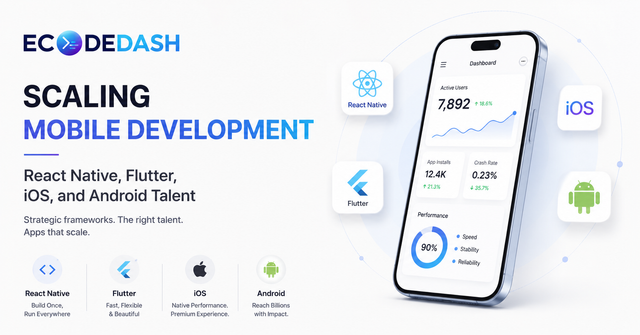
Introduction to Modern Mobile App Development
Mobile applications have fundamentally transformed how businesses interact with their consumers. As the digital ecosystem expands globally, the urgency to deliver seamless, high-performance mobile experiences has never been greater. There are billions of smartphone users worldwide, and for any modern enterprise, financial technology startup, or health-tech platform, a mobile application is no longer an optional add-on—it is the primary touchpoint for user engagement and revenue generation.
Consequently, mobile app development has evolved into a high-stakes, fast-paced arena. With a multitude of platforms and development frameworks available, technical leaders, CTOs, and engineering managers are consistently tasked with making pivotal decisions regarding their technology stacks. The complexity of modern mobile architecture, encompassing diverse ecosystems like React Native, Flutter, iOS, and Android, requires a highly strategic approach to software engineering and team building. Building a mobile application is only half the battle; maintaining, scaling, and continuously deploying updates demands a robust talent acquisition strategy.

The Evolution of Tech Talent Sourcing
The trajectory of mobile application development is intrinsically linked to the evolution of technology talent sourcing. Just a few years ago, the methodologies for scaling software engineering teams were incredibly rigid, geographically constrained, and heavily reliant on slow, localized hiring practices. If we analyze the market conditions and standard practices of it staff augmentation services 2019, companies faced prolonged recruitment cycles, extensive onboarding delays, and limited access to specialized cross-platform mobile experts. During that period, scaling a tech team often took several months, significantly delaying crucial product roadmaps.
Today, the technology talent landscape is radically different. With the global IT outsourcing market projected to reach a staggering $808B by 2025, speed and agility are the paramount metrics for corporate success. Businesses operating in highly competitive sectors can no longer afford to wait months to fill a critical mobile engineering role. This urgency has fueled the explosion of modern it staff augmentation services, which leverage advanced AI-powered curation to deploy pre-vetted, top-tier engineering talent in as little as 48 hours. By embracing these modern hiring frameworks, forward-thinking organizations can rapidly inject specialized skills—such as advanced mobile user interface design, complex state management, and native module integration—directly into their ongoing projects, ensuring that release cycles remain uninterrupted and their competitive advantages are fiercely sustained.
Native vs. Cross-Platform: A Strategic Blueprint
Before an organization begins to source external engineering talent, its technical leadership must make a foundational architectural decision: Native versus Cross-Platform development. This choice dictates the entire lifecycle of the application and heavily influences the required skill sets of the development team.
Native development entails building entirely distinct applications for iOS and Android. For Apple's ecosystem, engineers utilize Swift or Objective-C, while Android applications are primarily built using Kotlin or Java. This traditional approach yields applications that are highly optimized for their respective operating systems. Native apps provide unparalleled performance, butter-smooth animations, and seamless, direct access to device hardware—such as Bluetooth connectivity, advanced camera functionalities, and Augmented Reality (AR) sensors. However, the native route necessitates maintaining two separate codebases. This effectively doubles the required engineering effort, inflates the budget, and extends the time to market.
Conversely, cross-platform development frameworks enable software engineers to write a single, unified codebase that can be successfully deployed across both the iOS and Android environments. This modern approach drastically reduces development costs and accelerates deployment timelines. Frameworks like React Native and Flutter have matured significantly over the past several years, overcoming early historical performance bottlenecks to deliver near-native experiences that satisfy the rigorous demands of enterprise-grade applications.
The decision between a native and a cross-platform strategy dictates not only the technical trajectory of the mobile project but also the specific composition of the talent you need to acquire. For instance, a complex cross-platform initiative might be perfectly suited for a unified dedicated software development team, whereas a dual-native strategy requires distinct, specialized iOS and Android cohorts working in tandem under strict Agile methodologies.
Deep Dive into React Native Architecture
When navigating the expansive cross-platform ecosystem, React Native stands out as a universally adopted, highly robust framework. Originally developed and open-sourced by Meta (formerly Facebook), this JavaScript-based framework allows developers to construct mobile applications using React—a declarative programming paradigm already familiar to millions of web developers globally. The traditional architecture of React Native operates by utilizing an asynchronous bridge that translates JavaScript code into native platform UI elements. However, recent architectural overhauls, including the introduction of the JavaScript Interface (JSI) and the New Architecture, have highly optimized this process. These updates allow for synchronous communication between the JavaScript thread and native device modules, dramatically enhancing application performance and responsiveness.
Given its widespread industry adoption and code-reusability efficiencies, a multitude of organizations actively seek to hire react native developers to spearhead their mobile product initiatives. The ability to reuse significant portions of code across web platforms and mobile environments makes this framework incredibly attractive for startups building Minimum Viable Products (MVPs) and large enterprises modernizing legacy systems alike.
However, writing high-performance mobile code requires more than just a basic understanding of JavaScript; it requires an intricate understanding of mobile application lifecycles, memory profiling, and native bridge optimization. Therefore, when building mission-critical enterprise applications, it is absolutely essential to hire expert react native app developers who can navigate complex state management architectures (using libraries like Redux, Zustand, or MobX) and meticulously optimize UI render cycles.
Furthermore, the rapid pace of global digital transformation often leaves local, domestic talent pools heavily depleted. In enterprise scenarios where immediate, high-quality scaling is required, companies must aggressively hire react-native developers to meet strict, uncompromising deployment deadlines. To overcome local talent scarcity, forward-thinking CTOs and engineering directors look beyond their geographical borders, tapping into highly vetted global networks to find top-tier remote react native developers for hire. These remote engineers, when properly integrated through structured, disciplined staff augmentation models, provide the necessary velocity and technical expertise to bring sophisticated mobile products to market without compromising on software quality or architectural integrity.
The Rise of Flutter and the Modern Developer
Parallel to the market dominance of React Native is the meteoric rise of Flutter, Google's open-source UI software development toolkit. Unlike other frameworks that rely on native OEM widgets, Flutter utilizes the Dart programming language alongside its own high-performance rendering engine (historically the Skia engine, and increasingly the newly optimized Impeller engine). This unique architectural approach allows Flutter to draw every single pixel on the device screen independently, resulting in highly customized, deeply expressive user interfaces that look visually identical across all platforms and device form factors.
The role of a Flutter Developer has consequently evolved into one of the most highly sought-after engineering positions within the entire mobile technology ecosystem. A proficient Flutter Developer leverages a rich, expansive repository of pre-built, highly customizable widgets to construct complex, aesthetic UI layouts with remarkable speed. Additionally, they are highly adept at implementing sophisticated state management solutions such as Provider, Riverpod, or the BLoC (Business Logic Component) pattern, ensuring that the application remains highly responsive and scalable under heavy, asynchronous data loads.
Because Flutter bypasses the traditional JavaScript bridge entirely by compiling its Dart code directly into native ARM machine code, it is exceptionally well-suited for applications that require buttery-smooth, 60fps or 120fps animations and rigorous performance metrics. This underlying technical superiority in UI rendering continues to drive the intense, global industry demand for specialized Flutter engineering talent.
Native iOS and Android: When Specialization Reigns Supreme
Despite the incredible efficiencies offered by cross-platform frameworks, there are distinct, highly specific business scenarios where native mobile development remains the undisputed, optimal choice. Mobile applications that demand heavy computational lifting, complex background processing, or intricate, low-latency integration with proprietary hardware APIs must almost always be built natively.
In the iOS domain, Swift has become the undisputed standard, fully replacing Objective-C for new projects. Swift provides Apple developers with a powerful, safety-oriented, and highly readable syntax that integrates flawlessly with Apple's native Cocoa Touch frameworks. For applications relying heavily on ARKit for augmented reality, Core ML for on-device machine learning processing, or seamless, real-time Apple Watch integration, native iOS development is strictly mandatory. Furthermore, the introduction of SwiftUI has revolutionized how Apple developers build user interfaces, making native iOS development faster and more declarative than ever before.
Similarly, within the expansive Android ecosystem, Kotlin has definitively superseded Java as the globally preferred language for modern native Android development. Kotlin's concise syntax, built-in null-safety features, and full, two-way interoperability with legacy Java codebases make it incredibly powerful for enterprise teams. Android development requires a nuanced, deep understanding of device fragmentation, vastly varied screen dimensions, and the complex lifecycles of background services.
When stringent product requirements dictate this level of platform-specific technical depth, organizations typically establish a software development dedicated team focused entirely on either the iOS or Android platform. Maintaining a software development dedicated team for native code ensures that your software engineers are deeply immersed in the platform's specific design paradigms (like Apple's Human Interface Guidelines or Google's Material Design), latest SDK updates, and hardware performance optimization techniques, ultimately yielding a superior, uncompromising end product.

Structuring Your Talent: Finding the Right Engagement Model
Transitioning smoothly from technical architectural decisions to active team execution requires selecting the most effective talent engagement and hiring model. The global technology industry offers several distinct paradigms, and clearly understanding the operational differences between it managed services vs staff augmentation is critical for long-term project success.
Managed services typically involve outsourcing the entirety of a software project to an external, third-party vendor. This vendor assumes full, end-to-end responsibility for project management, technical architecture, and final product delivery. While this model successfully offloads operational risk, it often results in a significant loss of granular control over the daily development process and the underlying codebase quality.
Conversely, if you are searching for it staff augmentation services definition, it accurately describes a highly flexible talent integration strategy where thoroughly vetted, highly skilled external software engineers are temporarily added directly to your existing internal technology team. These augmented engineering professionals work under your direct management, utilize your internal communication tools (like Slack or Microsoft Teams), and align seamlessly with your internal Agile sprint workflows and Jira boards.
This model empowers technical leaders, VPs of Engineering, and CTOs to maintain strict oversight of the codebase architecture while dynamically scaling the engineering team's capacity up or down based on current project phases. Staff augmentation eliminates the heavy long-term financial overhead associated with traditional full-time recruitment (such as benefits, localized taxes, and severance) while providing immediate, on-demand access to specialized, top-tier mobile talent.
Procurement and Vendor Selection Strategies
For large-scale enterprise organizations, safely integrating augmented technology talent requires navigating highly established procurement and sourcing protocols. Procurement officers and enterprise vendor managers often need to establish clear, robust frameworks for rigorously evaluating potential talent providers. A very frequent inquiry within enterprise sourcing departments is how they can it staff augmentation services rfp efficiently to ensure that the chosen vendor consistently meets strict legal compliance, data security, and technical vetting standards.
A comprehensive Request for Proposal (RFP) for staff augmentation must meticulously detail the required technology stacks (e.g., React Native vs Native Swift), the specific seniority levels of the required software engineers, and any strict geographic or timezone overlap requirements necessary for daily stand-up meetings.
However, it is vital to acknowledge that the technology landscape evolves at breakneck speed. Procurement teams simply cannot rely on static, outdated corporate manuals—there is no magical it staff augmentation services 8th edition textbook that holds all the current answers for successfully sourcing modern Flutter experts or AI-integrated native developers. Agility must inherently be built into the procurement process itself. Modern, highly effective talent acquisition relies on dynamic, AI-driven tech platforms that continuously curate, test, and vet global talent pools in real time.
To initiate this agile procurement process, the traditional enterprise friction must be minimized. Often, the absolute fastest way to bridge a critical technical talent gap is remarkably simple: an enterprise leader or hiring manager just needs to reach out to a verified, reputable vendor's it staff augmentation services email address to immediately trigger a rapid technical discovery call. From there, specific engineering profiles can be reviewed, technical interviews can be conducted, and top-tier developers can be seamlessly onboarded in a matter of days rather than agonizing months.
Accelerate Your Mobile Roadmap with Ecode Dash
Ecode Dash stands proudly at the forefront of this new, dynamic era of mobile software engineering and talent acquisition. We deeply understand that whether you are actively building a unified cross-platform application using React Native or architecting highly complex, hardware-intensive native solutions, the quality of your engineering team is the ultimate determinant of your digital product's market success.
Our proprietary, AI-powered curation process ensures that only the top 5% of global tech talent successfully passes through our rigorous technical evaluations, system design assessments, and cultural fit validations. We provide immediate access to experts across over 50 technologies, encompassing specialized, high-demand roles from Flutter and cross-platform UI engineering to deep, native Swift and Kotlin development.
Whether your organization needs to scale up a distributed engineering team rapidly to meet a product launch or deploy an entire, dedicated software development team within 48 hours, Ecode Dash offers the highly flexible engagement models your business strictly requires. Stop waiting months for the right technical hire. Partner with Ecode Dash today, leverage elite global talent, and start accelerating your mobile app development roadmap with unmatched speed, quality, and precision.