Ecode Dash Blog
Scaling Mobile Engineering: Strategic Guide to Dedicated Teams & IT Staff Augmentation
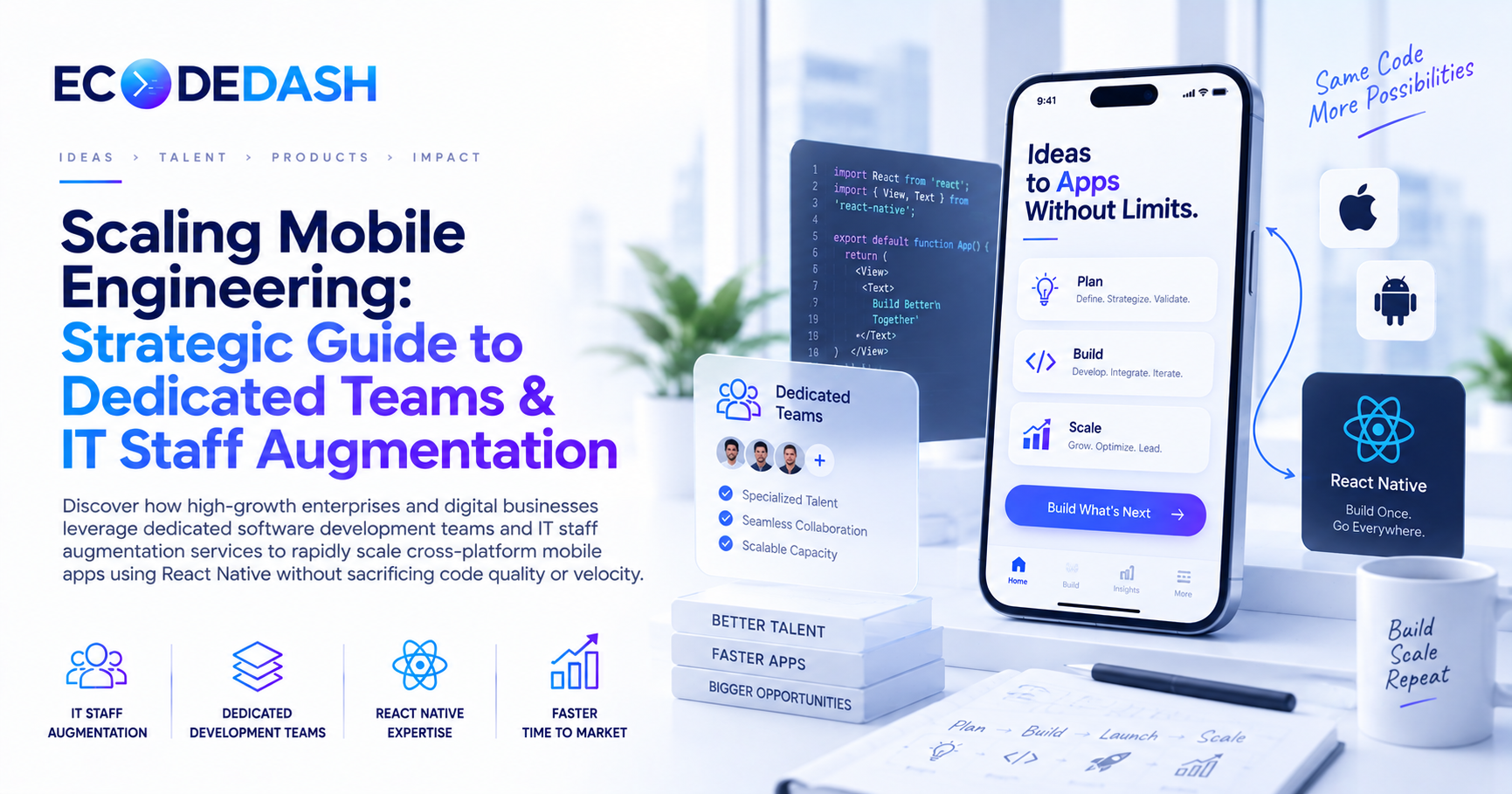
Discover how high-growth enterprises and digital businesses leverage dedicated software development teams and IT staff augmentation services to rapidly scale cross-platform mobile apps using React Native without sacrificing code quality or velocity.
By Ecode Dash Editorial Team · Software Engineering & Technology Consulting
In modern digital commerce and SaaS, product velocity dictates market dominance. Yet engineering executives face an acute paradox: while the demand for responsive, cross-platform mobile products accelerates, the timeline to recruit high-performing senior engineers has lengthened to an industry average of 60–90 days. For engineering leadership and growth officers aiming to protect capital reserves while shipping roadmap commitments on time, conventional local hiring cycles have become an unsustainable operational bottleneck.
To overcome this friction, forward-thinking organizations are transitioning away from slow, high-overhead domestic recruiting models toward agile talent delivery frameworks. By deploying a dedicated team for software development alongside strategic IT staff augmentation services in the USA and globally, engineering leaders can shorten deployment cycles from months to days while reducing burn rates by up to 60%.
This guide breaks down how digital enterprises evaluate engagement models, integrate top-tier mobile talent, and successfully hire dedicated React Native developers to drive predictable, revenue-aligned product development.

The Engineering Bandwidth Dilemma: In-House vs. Augmented Teams
Building an in-house mobile engineering division from scratch incurs compounding direct and indirect expenses. Beyond base salaries and benefits, recruiting domestic talent in tier-one tech hubs requires recruiter commissions, equity grants, workspace overhead, and prolonged onboarding ramp-ups. When unexpected churn occurs, the institutional knowledge loss can derail critical product releases.
+-----------------------+------------------------+--------------------------+
| Metric                | In-House Hiring        | IT Staff Augmentation    |
+-----------------------+------------------------+--------------------------+
| Time to Deploy        | 8 to 14 Weeks          | 48 to 72 Hours           |
| Sourcing & Vetting    | Internal HR / Recruiter| AI-Curated & Pre-Vetted  |
| Flexibility           | Low (Long-term commit) | High (Elastic scaling)   |
| Tech Stack Coverage   | Fixed Skillsets        | 50+ Specialized Stacks   |
| Cost Structure        | High Fixed Overhead    | Variable / Predictable   |
+-----------------------+------------------------+--------------------------+
When scaling complex digital products, leadership must assess whether to hire a dedicated software development team that operates autonomously or leverage affordable IT staff augmentation services to inject specialized firepower into existing sprint squads.
Core Differences Between Staff Augmentation and Dedicated Teams
- IT Staff Augmentation (Engineering Extension)
Staff augmentation integrates individual senior contributors into your existing engineering leadership structure. Augmented engineers attend your daily standups, push code directly to your repositories, and follow your Jira or Linear workflows. This framework is ideal when your core team has architectural leadership but lacks specialized bandwidth—such as when you need vetted react native developers for hire to execute a major app refactor.
- Dedicated Software Development Teams
A dedicated team in software development functions as a self-contained unit comprising frontend engineers, backend architects, QA automation specialists, and an agile project manager. The team assumes ownership over defined epics or complete product modules, delivering production-ready releases aligned with your technical roadmap.
Why React Native Remains the Gold Standard for Enterprise Mobile Stacks
Cross-platform efficiency is non-negotiable for digital products scaling across iOS and Android ecosystems. While native Swift and Kotlin development offer tailored device access, maintaining two discrete codebases doubles maintenance costs, bifurcates QA cycles, and causes feature parity delays.
Choosing to hire React Native app developers gives digital businesses distinct technical and commercial advantages:
- Unified Codebase (Up to 90% Code Reusability): Single-source state management and UI components streamline engineering velocity across platforms.
- Near-Native Performance via the New Architecture: Modern React Native leverage Fabric rendering and TurboModules (JSI) to eliminate legacy bridge serialization bottlenecks, unlocking 60 FPS animations and fluid interactions.
- Direct Ecosystem Synergy with React.js: Engineering organizations utilizing React for web apps can cross-leverage component logic, design systems, and developer familiarity across web and mobile platforms.
- Rapid Feature Iteration: Over-the-air updates and shared testing suites dramatically shorten continuous deployment pipelines.
Sourcing Talent: Global Hubs and Offshore Arbitrage
While domestic hiring in North America provides localized timezone synchronization, high demand has driven senior developer compensations to peak levels. To maximize capital efficiency without compromising delivery standards, engineering leaders often pair domestic architectural leads with offshore development centers.
Why Global Enterprises Hire React Native Developers in India
India has evolved into one of the world's most sophisticated technical talent hubs, graduating hundreds of thousands of specialized computer science professionals annually. Sourcing through vetted talent partners allows US and European organizations to hire React Native app developers in India who bring:
- Deep Technical Rigor: Senior developers with proven track records across FinTech, HealthTech, E-Commerce, and high-scale SaaS architectures.
- Timezone Overlap and Clear Communication: Structured shift coverage ensuring real-time collaboration during North American or European working hours.
- Proven Cost Efficiency: Accessing elite developers through established talent curation platforms delivers substantial cost savings compared to traditional domestic hiring, freeing capital for growth and acquisition channels.
When evaluating IT staff augmentation services USA providers, look for partners that offer end-to-end vetting protocols rather than generic freelance marketplace listings.

4-Stage Vetting Framework for Senior React Native Engineers
To ensure enterprise-grade code quality, leading engineering organizations apply strict assessment funnels where only the top 5% of candidate engineers are selected. When preparing to hire dedicated React Native developers, evaluate candidates across these critical validation stages:
  [ Stage 01: Requirement Discovery & Stack Mapping ]
                         │
                         ▼
  [ Stage 02: AI-Powered Talent Curation & Portfolio Review ]
                         │
                         ▼
  [ Stage 03: Live System Design & Coding Benchmarks ]
                         │
                         ▼
  [ Stage 04: Technical Onboarding & 48-Hour Deployment ]
1. Architectural & State Management Mastery
Evaluate deep understanding of modern React state architectures, including Redux Toolkit, Zustand, MobX, and React Query/RTK Query. Assess how candidates isolate business logic from presentation layers and manage complex offline-first synchronization.
2. Native Bridge & Module Integration
Senior candidates must demonstrate capability beyond standard JavaScript components. They should possess hands-on experience bridging Objective-C/Swift (iOS) and Java/Kotlin (Android) SDKs, implementing custom native modules for hardware integrations (Bluetooth LE, biometric auth, camera hardware, geofencing).
3. Memory Management and Profiling
Probe candidates on diagnosing memory leaks, optimizing image caching strategies with libraries like FastImage, and profiling JavaScript thread bottlenecks using Flipper, Xcode Instruments, and Android Studio Profiler.
4. Automated Testing and CI/CD Automation
Top-tier engineers write resilient test suites using Jest, React Native Testing Library, and Detox or Appium for end-to-end automation. They should be well-versed in continuous delivery pipelines configured via Fastlane, GitHub Actions, or Bitrise.
Engagement Models for Scaling Product Engineering
Choosing the right structure depends on project maturity, internal management bandwidth, and delivery deadlines:
Model A: Engineering Extension (Staff Augmentation)
- Best For: Filling immediate skill gaps, accelerating sprint velocity, handling specialized epics.
- Governance: Managed directly by your internal Engineering Managers and Tech Leads.
- Flexibility: Seamless ramp-up and ramp-down based on quarterly roadmap priorities.
Model B: Dedicated Squad (Turnkey Engineering Team)
- Best For: Greenfield product builds, complete platform rewrites, building secondary mobile apps.
- Governance: Self-managed cross-functional team with a dedicated delivery lead reporting to your VP of Product.
- Deliverables: Milestone-based sprint delivery with full SLA and code quality guarantees.
Model C: Hybrid Distributed Pods
- Best For: Enterprise organizations requiring 24/7 continuous development cycles.
- Governance: Core architects in the US paired with a dedicated team of software development engineers in global delivery centers for around-the-clock throughput.
Step-by-Step Onboarding Playbook for Augmented Developers
Successful integration of remote or augmented talent requires deliberate documentation and environment setup. Follow this standard 72-hour onboarding protocol to drive immediate developer productivity:
- Environment Sandboxing & Zero-Trust Access
Provision least-privilege repository access, ephemeral development credentials, and staging API tokens. Ensure security compliance (SOC2, HIPAA, or GDPR) via VPN and managed developer environments.
- Architecture Briefing & RFC Documentation
Provide clear architecture decision records (ADRs), component library documentation (Storybook), design tokens (Figma), and API contract specifications (Swagger/Postman).
- First-Day PR Milestone
Assign a low-complexity task, such as fixing a minor UI ticket or updating a non-critical integration test, to ensure the local build, linter, and CI/CD pipelines compile without friction within day one.
- Structured Mentorship & Daily Async Syncs
Pair new engineers with a senior in-house buddy for the first two sprints to accelerate context transfer and clarify team PR review conventions.
Key Metrics to Track Augmented Engineering ROI
To ensure your top IT staff augmentation services deliver measurable business value, engineering executives should track quantifiable performance metrics:
- Sprint Velocity & Pull Request Throughput: Measure completed story points per sprint cycle to verify output consistency.
- Lead Time for Changes: Track the duration from initial commit to production deployment.
- Defect Escape Rate: Monitor regressions and production bugs introduced into release branches.
- Cost per Feature Shipped: Compare the fully loaded cost of augmented squads versus historical in-house delivery benchmarks.
By holding augmented engineering teams to explicit delivery standards, growth-focused organizations ensure seamless team integration while maintaining uncompromising code standards.
Scale Your Engineering Capacity with Ecode Dash
Eliminate months of hiring delays and gain instant access to senior, pre-vetted mobile and full-stack developers. Whether you need to integrate elite cross-platform specialists or deploy an autonomous, high-performance sprint squad, Ecode Dash connects you with the top 5% of global engineering talent deployed within 48 hours.
Explore our flexible talent models and discover how our Engineering Extension Team solutions empower modern enterprises to build faster, reduce overhead, and scale engineering with complete confidence.