Ecode Dash Blog
Scaling Up with Engineering Extension Teams: A Complete Guide to Accelerated Growth
Learn how to accelerate growth and scale your technical capabilities effortlessly using an engineering extension team, affordable IT staff augmentation services, and dedicated software development teams.
By Ecode Dash Editorial Team · Software Engineering & Technology Consulting
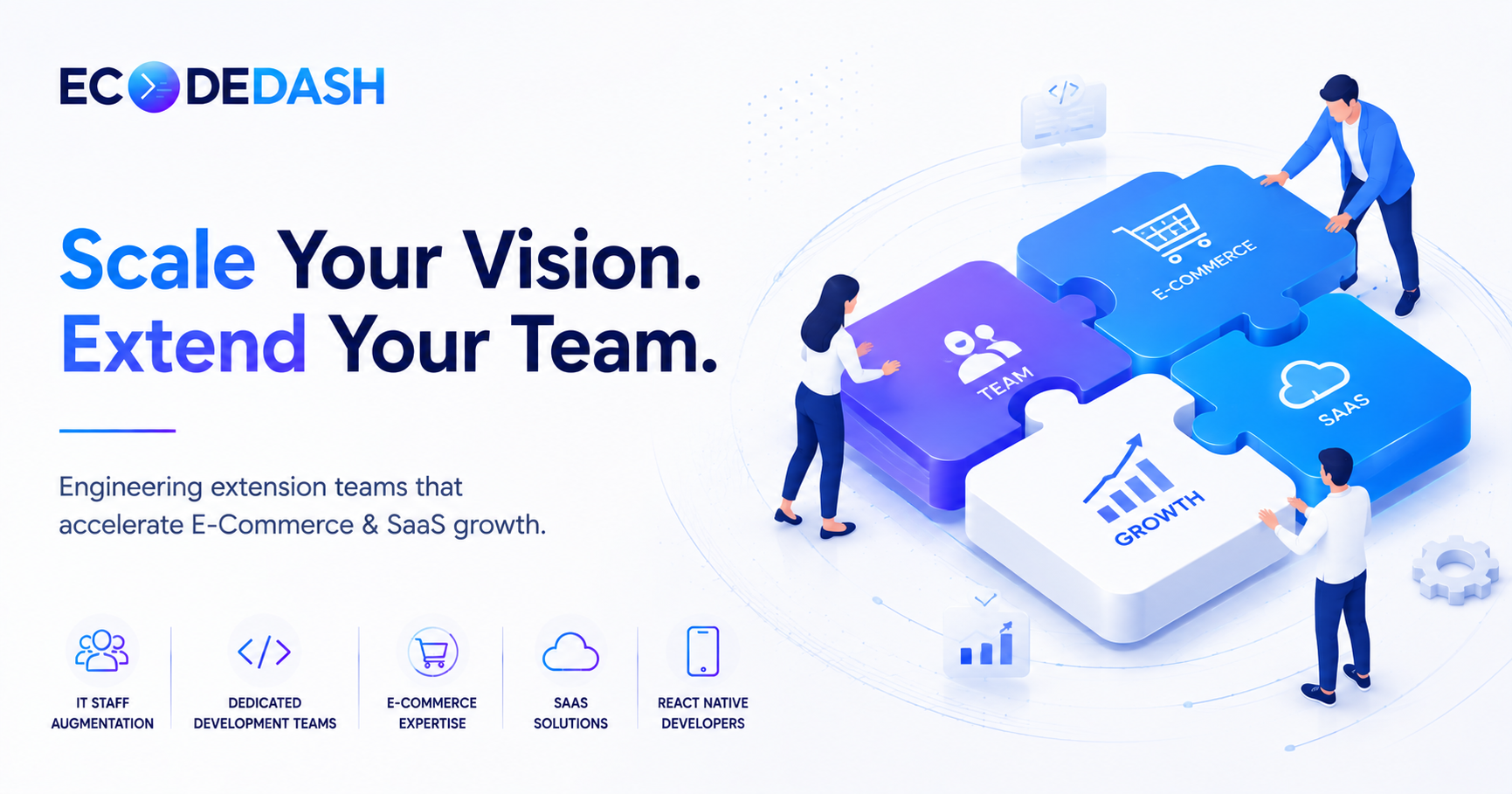
In today's hyper-competitive digital landscape, the speed at which you can innovate often dictates your market position. However, scaling your technological capabilities is rarely a simple equation. As product roadmaps become more ambitious and the pressure to deliver new features mounts, companies face a critical bottleneck: finding, hiring, and retaining top-tier engineering talent. This is where the concept of an Engineering Extension Team comes into play. Rather than struggling with the traditional, painfully slow recruitment cycles, forward-thinking organizations are embracing flexible hiring models to supercharge their growth.

The challenge is universal. Startups fresh off a funding round need to deploy capital efficiently to capture market share, while established enterprises must modernize legacy systems without disrupting ongoing operations. In both scenarios, the internal HR engine often cannot keep pace with the technical demands. This reality has fueled the rapid rise of affordable IT staff augmentation services, fundamentally changing how businesses approach capacity planning and resource allocation.
By seamlessly integrating external talent with your in-house engineers, you create a unified force capable of tackling complex challenges at unprecedented speeds. This article explores the strategic advantages of team scaling, the nuances of building a dedicated software development team, and practical insights on how to source specialized talent—such as when you need to hire React Native developers—to keep your projects on track and within budget.
The Modern Hiring Dilemma: Why Traditional Recruitment is Slowing You Down
To understand the value of an extension team, we must first examine the flaws inherent in the traditional hiring process. According to industry data, the average time to hire a senior software engineer can easily stretch from two to four months. During this period, product development stalls, competitors gain ground, and existing team members are burdened with the extra workload, leading to burnout and decreased morale.
Moreover, the true cost of a bad hire can be catastrophic. When you factor in recruitment fees, onboarding time, salaries, and the potential impact of delayed milestones, making a mistake in the traditional hiring process is an expensive risk. Businesses are increasingly realizing that locking themselves into rigid, permanent headcount structures limits their agility in a market that demands constant adaptation.
This paradigm shift is reflected in the numbers. The Engineering Team Services market is projected to reach $131 billion by 2026, driven by a 7.4% expected market growth. Companies are no longer asking if they should outsource; they are asking how they can do it smarter, more efficiently, and with higher quality outcomes. They are looking for ways to hire a dedicated software development team that operates not as a distant third-party vendor, but as an organic extension of their own culture and processes.
Understanding the Engineering Extension Team Model
So, what exactly differentiates an Engineering Extension Team from traditional outsourcing?
In a classic outsourcing model, a project is handed over the wall to an external agency. The vendor manages the project, the resources, and the delivery timeline. While this can work for isolated, non-core projects, it often leads to a disconnect in product vision, communication breakdowns, and a lack of transparency. The code that comes back might function, but it may not align with your internal coding standards or long-term architectural goals.
An Engineering Extension Team, on the other hand, is built on the premise of deep integration. When you opt to hire dedicated software development team members through this model, these professionals become a part of your daily stand-ups, your Slack channels, and your agile ceremonies. They report directly to your technical leadership, use your preferred project management tools, and align with your company's core values.
This model provides the best of both worlds: the immediate scalability and specialized expertise of external talent, combined with the control, cultural alignment, and security of an in-house team. Whether you need a single software development dedicated team to handle a massive backend migration, or a handful of specialized engineers to accelerate a specific feature, the extension model offers unparalleled flexibility. It transforms IT staff augmentation services from a tactical stopgap into a strategic growth lever.
Key Triggers: When is it Time for Team Scaling?
Recognizing the right moment to scale your team is crucial for maintaining momentum without overextending your budget. Several common scenarios typically trigger the need for an extension team:
- Accelerated Product Roadmaps: When the executive board or investors demand faster time-to-market for critical features, relying solely on your existing team is a recipe for missed deadlines. An extension team injects immediate velocity into your development cycles.
- The Need for Specialized Expertise: Technology evolves rapidly, and it's rare for an in-house team to possess every conceivable skill. For instance, if your company decides to launch a mobile application, you might suddenly need to hire React-Native developers. Instead of spending months searching for this niche expertise, an extension model allows you to tap into pre-vetted talent pools instantly.
- Post-Funding Growth: After closing a Series A or B funding round, the pressure to scale operations and demonstrate ROI is immense. Startups need to scale their engineering output overnight. A dedicated extension team provides the manpower required to execute the expanded vision without the long lead times of traditional hiring.
- Tackling Technical Debt: While your core team focuses on building new revenue-generating features, an extension team can be deployed to refactor legacy code, improve system architecture, and eliminate technical debt, ensuring the long-term stability of your platform.
- Seasonal or Project-Based Peaks: Some businesses experience cyclical demand. Rather than carrying the overhead of a massive full-time team year-round, companies can scale up and down dynamically, leveraging affordable IT staff augmentation services to match their exact capacity needs at any given time.
Staff Augmentation vs. Managed Projects vs. Dedicated Teams
To fully leverage external talent, it's vital to understand the different engagement models available and choose the one that aligns with your operational maturity and project goals.
- Staff Augmentation: In this model, you are essentially plugging skill gaps within your existing team. If you have a solid engineering management structure in place but just need extra hands, staff augmentation provides individual contributors who seamlessly blend into your current processes.
- Managed Projects: This is the traditional outsourcing route. You define the scope, budget, and timeline, and the vendor takes complete ownership of delivering the final product. This is ideal for well-defined, isolated projects where you don't need deep integration with your internal teams.
- Dedicated Teams (The Extension Model): This sits between augmentation and managed projects. When you hire a dedicated software development team, you get an entire pod—often including a project manager, QA engineers, and developers—that functions autonomously but is deeply integrated into your company's strategic goals. They don't just write code; they participate in architecture discussions and contribute to product strategy. This model is perfect for long-term team scaling, where you need sustained output without the overhead of managing every individual contributor directly.
Deep Dive: The Strategic Value of IT Staff Augmentation Services
The phrase "staff augmentation" often conjures images of temporary, low-level contractors brought in to do grunt work. However, the modern reality of IT staff augmentation services is vastly different. Today's augmentation providers focus on supplying elite, senior-level talent capable of driving strategic initiatives.
When you partner with a premium provider like Ecode Dash, you aren't just filling seats; you are acquiring intellectual capital. The multi-stage vetting process ensures that only the top 5% of candidates make it through, evaluating not just technical prowess through rigorous system design tests, but also communication skills and cultural fit. This level of curation guarantees that the engineers you bring on board are ready to contribute meaningfully from day one.
Furthermore, the economic advantages of this model cannot be overstated. Building a world-class engineering hub in tech hotspots like San Francisco, New York, or London is prohibitively expensive for many organizations. By looking globally, companies can access highly skilled professionals at a fraction of the cost. This geographical arbitrage allows businesses to invest more in product innovation, marketing, and customer acquisition.

Spotlight on Mobile: Scaling Mobile App Development
One of the most frequent catalysts for team scaling is the decision to expand into the mobile ecosystem. In 2026, the demand for robust, high-performance mobile applications continues to skyrocket across all industries, from FinTech to E-commerce. However, building native apps separately for iOS and Android requires two distinct development teams, doubling the cost and complexity of the project.
This is why cross-platform frameworks, particularly React Native, have become the gold standard for modern mobile development. React Native allows engineers to write a single codebase that deploys seamlessly across both platforms, dramatically reducing time-to-market and maintenance overhead. Consequently, the scramble to hire React Native app developers is more intense than ever.
When companies decide to hire dedicated React Native developers, they often look beyond their local talent pools. The global shortage of these specialized engineers means that local hiring can take months and command exorbitant salaries. This dynamic has made international talent hubs incredibly attractive.
The Strategic Advantage of Sourcing Talent Globally
Specifically, the trend to hire React Native developers in India has gained massive traction. India has long been recognized as a powerhouse of technical talent, producing millions of engineering graduates annually. By choosing to hire React Native developers India, companies can tap into a deep, highly experienced talent pool that is well-versed in the latest mobile architectures and agile methodologies.
Whether you are looking for React Native developers for hire to build a brand new consumer-facing application or to migrate an existing web platform to mobile, partnering with a firm that specializes in providing a software development dedicated team ensures you get seasoned professionals who can navigate the complexities of state management, API integrations, and app store deployments.
By leveraging this global talent pool, your organization can maintain round-the-clock development cycles. A well-structured distributed team can mean that while your local engineers are offline, your extension team is reviewing code, running automated tests, and pushing updates, dramatically compressing the overall time-to-market.
How to Hire a Dedicated Software Development Team Successfully
While the benefits of an extension team are clear, executing this strategy successfully requires careful planning and the right partner. If you are preparing to hire dedicated software development team members, consider the following best practices:
- Define Your Objectives Clearly: Before reaching out to a vendor, articulate exactly what you want to achieve. Are you looking to build a specific product module, increase overall development velocity, or bring in specialized skills like AI/ML or cloud architecture? A clear requirement discovery phase is the foundation of a successful engagement.
- Prioritize Cultural Alignment: Technical skills are essential, but cultural fit determines the long-term success of the integration. Look for professionals who are proactive communicators, comfortable in agile environments, and share your commitment to quality. The best providers conduct rigorous culture fit checks during their multi-stage vetting process.
- Establish Seamless Communication: When working with distributed teams, communication is the lifeblood of the project. Ensure that your external team operates with overlapping time zones, speaks fluent English, and utilizes the same collaboration tools (Slack, Jira, GitHub) as your internal staff.
- Demand Transparency and Accountability: A reliable partner will provide full visibility into the development process. You should have direct access to the engineers, regular progress reports, and the ability to track metrics such as code quality, sprint velocity, and bug rates.
- Start Small and Scale: If you are new to the extension model, consider starting with a small pilot project or a core group of 2-3 engineers. Once you have established the workflow and proven the ROI, you can confidently scale up to a larger dedicated software development team.
Overcoming Common Objections to Team Scaling
Despite the overwhelming evidence supporting the extension model, some technical leaders remain hesitant. Let's address a few common objections:
- "It takes too much time to onboard external developers." While onboarding is always required, premium IT staff augmentation services provide engineers who are accustomed to jumping into complex codebases quickly. Because they are senior professionals, their ramp-up time is significantly shorter than that of a new, direct hire. Furthermore, partners like Ecode Dash aim for deployment within 48 hours, radically accelerating the timeline.
- "I'm worried about code quality and security." When you hire a dedicated software development team through a reputable provider, you are protected by stringent NDAs, secure infrastructure protocols, and rigorous quality assurance standards. These engineers adhere to your internal coding guidelines and participate in your peer review processes, ensuring the output meets your exact specifications.
- "What if the developer isn't a good fit?" A key advantage of the flexible hiring model is risk mitigation. If a developer isn't meeting expectations, top-tier providers will replace them quickly and without extra cost, ensuring your project continues without prolonged disruptions.
The Role of AI in Curating Tech Talent
As we move deeper into the 2020s, the process of finding the right talent has been revolutionized by Artificial Intelligence. Traditional recruitment relies heavily on manual resume screening, which is often biased, slow, and prone to error. Forward-thinking companies are now utilizing AI-powered talent curation to match the specific technical requirements of a project with the proven capabilities of candidates.
By analyzing vast datasets of developer performance, coding test results, and past project success, AI algorithms can instantly shortlist the highest-fit individuals from a global talent network. This ensures that when you set out to assemble a full-stack software development dedicated team, you are presented with profiles that are mathematically aligned with your needs. This technological advantage is how platforms like Ecode Dash can promise top-tier talent deployment in just 48 hours.
Building a Resilient and Agile Organization
The ultimate goal of adopting an Engineering Extension Team is not merely cost savings; it is about building a more resilient, agile, and competitive organization. In an era where technological disruption is a constant, the ability to pivot rapidly, scale resources on demand, and access global expertise is a massive competitive advantage.
By integrating affordable IT staff augmentation services into your broader talent strategy, you insulate your company from the volatility of the local hiring market. You ensure that your product roadmap is never held hostage by an empty seat in the engineering department. You empower your core team to focus on high-level architecture and innovation, knowing that they have the specialized support they need to execute the vision flawlessly.
Conclusion: Accelerating Your Vision with Ecode Dash
Scaling a technology company is an intricate dance of balancing ambition with execution. The traditional methods of talent acquisition are no longer sufficient to keep pace with the demands of the modern digital economy. By embracing the extension model, organizations can unlock unprecedented levels of agility, efficiency, and innovation.
Whether your immediate goal is to rapidly hire dedicated React Native developers to launch a game-changing mobile app, or to strategically assemble a large-scale team to modernize your enterprise infrastructure, the path forward requires a partner who understands the nuances of modern engineering.
This is where Ecode Dash excels. By combining AI-curated talent matching with a rigorous multi-stage vetting process that admits only the top 5% of professionals, we connect you with pre-vetted engineers ready to integrate within 48 hours. From full-stack developers and cloud architects to specialized mobile experts, our flexible engagement models are designed to seamlessly align with your specific technical and cultural requirements.
Stop waiting months for the right hire and watching your product roadmap stall. Embrace the new age of hiring and scale your team intelligently with proven, elite talent.
Ready to supercharge your development cycles? Discover how a custom-built Engineering Extension Team can transform your development lifecycle and propel your business toward its most ambitious goals.