Ecode Dash Blog
The Strategic Guide to IT Staff Augmentation: How to Hire Dedicated React Native Developers & Software Teams
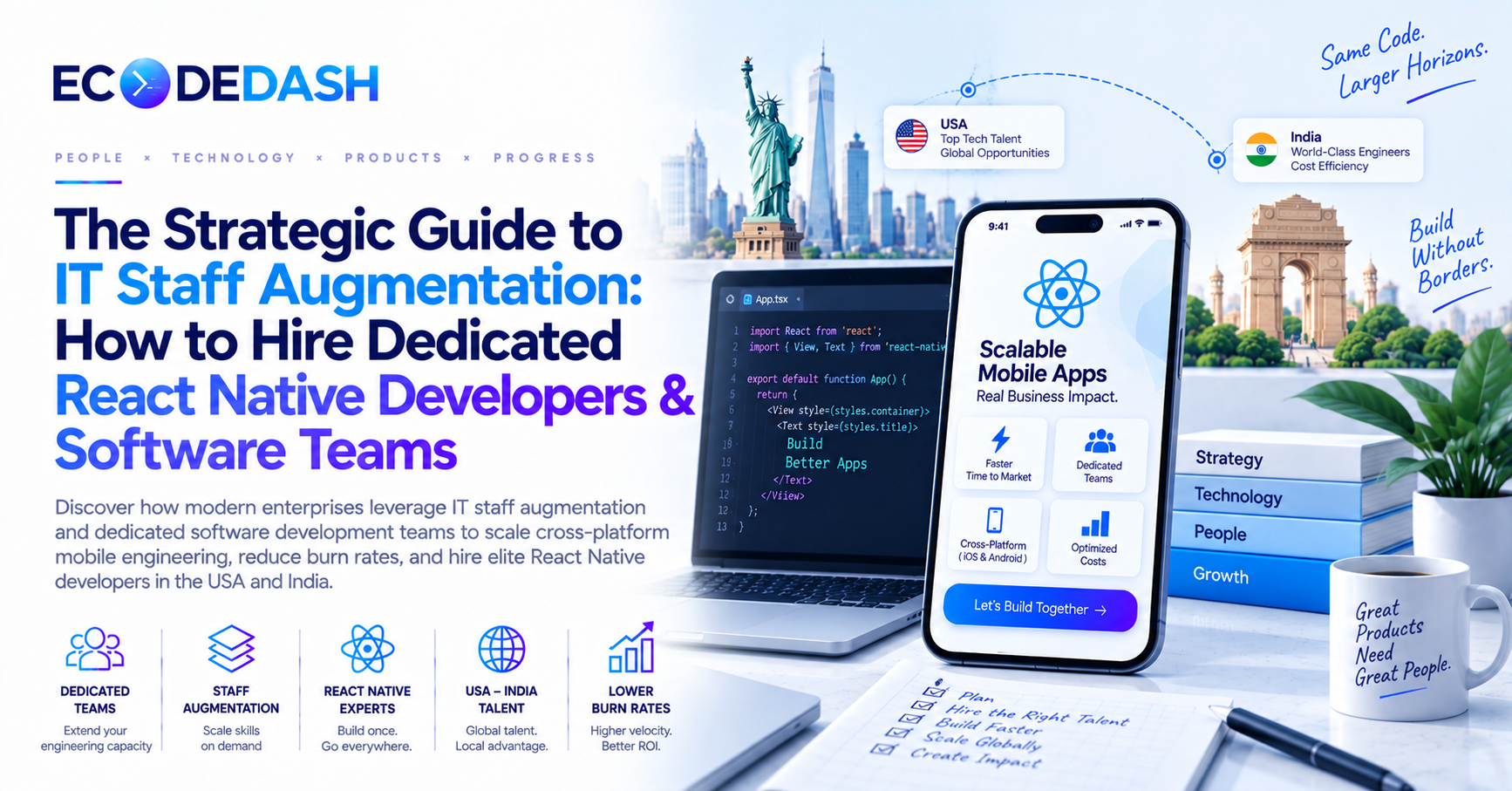
Discover how modern enterprises leverage IT staff augmentation and dedicated software development teams to scale cross-platform mobile engineering, reduce burn rates, and hire elite React Native developers in the USA and India.
By Ecode Dash Editorial Team · Software Engineering & Technology Consulting
In an era defined by aggressive product roadmaps, tightening capital efficiency, and fierce competition for technical talent, modern engineering leaders face an unrelenting dilemma: how do you ship enterprise-grade software at breakneck speed without blowing past your operational budget?
Whether you are modernizing a legacy enterprise architecture or building a flagship mobile experience from scratch, conventional in-house hiring cycles—often stretching between 60 to 90 days per senior role—create debilitating bottlenecks. This reality has driven high-growth enterprises and mid-market innovators toward modern flexible models: structured staff augmentation and fully dedicated engineering squads.
This comprehensive guide explores the strategic mechanics of scaling your technical footprint. We break down when and how to hire a dedicated software development team, evaluate the economics of top IT staff augmentation services, and uncover the exact playbook required to hire dedicated React Native developers capable of delivering high-performance cross-platform applications across global markets.
The Evolution of Engineering Capacity: Staff Augmentation vs. Dedicated Teams
Before executing a hiring initiative, technical executives must establish the exact operational model required for their stage of maturity. The two most effective models dominating the global software services landscape are Staff Augmentation and Dedicated Teams.
+-----------------------------------------------------------------------------------------+
|                                 CAPACITY ENGAGEMENT MODELS                               |
+------------------------------------+----------------------------------------------------+
| Staff Augmentation                 | Dedicated Development Team                         |
+------------------------------------+----------------------------------------------------+
| • Direct individual contributors   | • Autonomous, cross-functional squads              |
| • Plug into existing sprint rituals| • Self-managed or hybrid management workflows      |
| • Managed directly by internal PMs | • Includes PM, Tech Lead, QA, & Domain Engineers   |
| • Scales up/down on demand (hours) | • Ideal for end-to-end features or greenfield apps |
| • Solves hyper-targeted skill gaps | • Delivers strategic product roadmaps long-term    |
+------------------------------------+----------------------------------------------------+
1. Flexible IT Staff Augmentation
Staff augmentation involves embedding external, specialized engineers directly into your in-house teams. These developers report to your engineering managers, attend your standups, push code to your repositories, and follow your internal CI/CD pipelines.
For enterprise teams in North America, leveraging IT staff augmentation services in USA offers immediate relief during critical sprint pushes, architecture refactors, or technology transitions without the long-term overhead of healthcare benefits, equity grants, and payroll compliance.
2. The Dedicated Team for Software Development
When your product backlog demands an autonomous unit capable of owning full architectural cycles, assembling a dedicated team of software development professionals is the superior path. Rather than sourcing individual contractors piecemeal, an enterprise engages a pre-formed squad—often consisting of senior frontend engineers, backend architects, QA automation specialists, and a technical project manager.
A dedicated team in software development operates as a natural extension of your brand. They take ownership of defined subsystems, feature modules, or entire mobile applications, allowing your core in-house leadership to maintain laser focus on proprietary core IP.
Why React Native Remains the Enterprise Standard for Cross-Platform Mobile
Among modern mobile frameworks, React Native continues to dominate enterprise product roadmaps. Backed by Meta and an expansive open-source ecosystem, it allows organizations to maintain a unified codebase across iOS and Android while preserving near-native rendering speeds and access to underlying platform APIs.
+-----------------------------------------------------------------------------+
|                        REACT NATIVE ENTERPRISE ROI                          |
+-----------------------------------------------------------------------------+
|  Unified Codebase  ---> 40% - 50% Reduction in Time-to-Market               |
|  Shared Business Logic ---> Single Source of Truth across iOS & Android    |
|  Native Bridge / JSI  ---> Near-Zero Latency for Complex Micro-Interactions |
|  Developer Liquidity ---> Leverages Broad TypeScript & React Ecosystem     |
+-----------------------------------------------------------------------------+
When companies look to hire React Native app developers, they are investing in structural advantages:
- Accelerated Time-to-Market: Feature parity across platforms is achieved simultaneously, eliminating delayed rollouts between iOS and Android.
- Reduced Maintenance Burden: Bug fixes, state management updates, and API contract modifications are implemented once, drastically reducing maintenance overhead.
- Native Bridge & JSI Architecture: With the modern React Native New Architecture (Fabric renderer and TurboModules via JavaScript Interface - JSI), performance bottlenecks on memory-heavy interfaces have been effectively neutralized.
- Broad Talent Availability: Because React Native is rooted in TypeScript/JavaScript, teams can recruit from a deep pool of modern web and mobile specialists.
However, building complex offline-first capabilities, handling deep hardware integrations, or optimizing cryptographic payloads requires specialized mastery. Finding qualified React Native developers for hire who understand both low-level native bridge bridging (Swift/Kotlin) and high-level React state architectures is where many organizations struggle.
The Global Talent Equation: USA Onshore vs. India Offshore Augmentation
As organizations optimize their engineering expenditures, hybrid geographical strategies have emerged as the industry standard. Pairing onshore architecture leads with offshore development centers unlocks around-the-clock productivity.
Navigating IT Staff Augmentation Services USA
When regulatory mandates, extreme real-time collaboration requirements, or defense/healthcare compliance dictate domestic execution, enterprise organizations turn to IT staff augmentation services USA.
- Pros: Complete timezone synchronicity, deep alignment with domestic enterprise workflows, frictionless security compliance (HIPAA, SOC 2, FedRAMP).
- Challenges: Premium cost structure, with senior mobile engineers commanding fully loaded hourly rates ranging from $120 to $220/hour.
Why Global Enterprises Hire React Native Developers in India
To secure world-class technical capabilities while controlling burn rates, top product organizations consistently hire React Native developers in India. India’s mature engineering hubs—Bangalore, Hyderabad, Pune, and Delhi NCR—house millions of software engineers with extensive experience building apps for Fortune 500 brands, global fintechs, and high-growth venture-backed startups.
When companies hire React Native developers India through premier partners, they capture distinct benefits:
- Cost Efficiency Without Quality Compromise: Access senior engineers at 60% to 75% lower cost compared to domestic hiring markets, unlocking affordable IT staff augmentation services that scale sustainably.
- 24/7 Follow-the-Sun Delivery: Distributed teams provide continuous delivery cycles, where code written during the offshore workday is reviewed and deployed during Western business hours.
- Deep Technical Talent Pools: India produces hundreds of thousands of STEM graduates annually, with extensive specialization in TypeScript, React, Native Modules, and cloud backend integrations.
If you plan to hire React Native app developers India, the critical differentiator lies in partner vetting. Top-tier providers enforce rigorous technical filtering, ensuring candidates possess excellent communication skills, mastery of automated testing, and proven experience with high-scale applications.
Key Evaluation Criteria: How to Vet Dedicated React Native Engineers
Evaluating external engineers requires a multi-stage technical assessment. Rote trivia questions are insufficient; your technical interview should assess real-world architectural design, state synchronization, and memory profiling.
Core Competencies to Look for When You Hire Dedicated React Native Developers
+----------------------------------------------------------------------------------------+
|                         TECHNICAL SCREENING SCORECARD                                  |
+-----------------------+----------------------------------------------------------------+
| Architectural Layer   | Critical Competency to Validate                                |
+-----------------------+----------------------------------------------------------------+
| State Management      | Redux Toolkit, Zustand, MobX, TanStack Query, Offline caching  |
| Native Integration    | CocoaPods, Gradle, TurboModules, bridging Swift/Kotlin to JS   |
| Rendering Performance | Reanimated 3, FlashList, memoization, frame-rate profiling     |
| Security & Compliance | Keychain/Keystore storage, SSL pinning, biometric auth flows   |
| CI/CD & Delivery      | Fastlane, GitHub Actions, CodePush, TestFlight, Play Console   |
+-----------------------+----------------------------------------------------------------+
Sample Architectural Scenario for Candidate Interviews
> "How would you architect an offline-first mobile application that synchronizes thousands of encrypted records with an enterprise PostgreSQL backend over intermittent cellular connections, ensuring zero data loss and conflict resolution?"
Senior candidates should immediately discuss:
- Local Persistent Storage: WatermelonDB or SQLite utilizing low-level C++ bindings for blazing read/write operations.
- Synchronization Strategies: Vector clocks, CRDTs (Conflict-free Replicated Data Types), or deterministic server-wins resolution algorithms.
- Background Sync: Utilizing headless task runners (such as `react-native-background-actions`) to handle queue drains without locking UI execution.
- Memory Profiling: Tracking memory footprint via Flipper and Chrome DevTools to eliminate memory leaks originating in uncleaned event listeners or heavy unmemoized component trees.
Step-by-Step Blueprint: Building Your Dedicated Software Team
Scaling an engineering organization using an augmented model requires an intentional rollout. Follow this five-phase framework to integrate external engineers smoothly into your development lifecycle:
Phase 1: Tech Stack & Skill Matrix Mapping
Document your exact needs. Are you building a greenfield project or integrating into an established microservices environment? Define the required tech stacks: React Native, GraphQL, Node.js, AWS/GCP, Docker, and specific DevOps orchestrations.
To discover how modern enterprises assemble high-velocity engineering squads within 48 hours, explore an engineering extension team and flexible IT staff augmentation services designed for rapid technical scaling.
Phase 2: Partner Selection & Vetting Pipeline
Work exclusively with talent partners that maintain a rigorous multi-stage filtering process. Demand that candidate profiles pass:
- Live coding assessments covering algorithmic efficiency and clean architecture.
- System design reviews (mobile lifecycle, caching, database modeling).
- English communication and cultural alignment evaluations.
- Historical code portfolio reviews on GitHub or production apps on the App Store/Google Play.
Phase 3: Frictionless Onboarding & Tooling Integration
Treat augmented engineers as first-class team members from Day One:
- Access Provisioning: Single Sign-On (SSO), VPN credentials, GitHub/GitLab repository access, and Jira/Linear boards.
- Architecture Briefing: Provide detailed documentation regarding state flows, API schemas, design systems (Figma), and CI/CD pipelines.
- Pair Programming Sessions: Assign an internal technical mentor for the first two sprints to accelerate domain knowledge transfer.
Phase 4: Establishing Agile Governance & Sprint Rhythm
Implement standardized metrics to monitor delivery velocity and code quality without micromanagement:
- Cycle Time & Lead Time: Track the time from initial commit to production deployment.
- PR Review Velocity: Ensure pull requests are reviewed within 24 hours across timezones.
- Test Coverage: Enforce automated unit test coverage thresholds (>80%) via Jest and Detox before PRs can merge.
Phase 5: Continuous Feedback & Scaling Flexibility
Establish quarterly reviews to evaluate team velocity. Flexible augmentation contracts should allow you to scale up headcount during heavy delivery windows or transition seamlessly into long-term retainer support.
Comparing Pricing Models: Finding the Balance Between Cost and Quality
Navigating global rate cards is essential for accurate financial modeling. Below is a comparative breakdown of engagement costs across top software talent corridors:
| Engagement Model / Region | Typical Hourly Rate (USD) | Monthly Cost per Senior Dev (USD) | Best Suited For |
|---|---|---|---|
| US Onshore Staff Augmentation | $120 – $220 / hr | $19,000 – $35,000 | Strict security compliance, heavy executive co-location |
| Nearshore (Latin America / CEE) | $65 – $110 / hr | $10,500 – $17,500 | Real-time timezone overlap with moderate cost savings |
| India Dedicated Engineering Squads | $25 – $65 / hr | $4,000 – $10,500 | High-scale capacity, complete product ownership, continuous delivery |
| Hybrid (US Lead + India Team) | $45 – $85 / hr (Blended) | $7,000 – $13,500 | Enterprise product delivery balancing governance & cost |
By leveraging trusted offshore and hybrid teams, technology leaders can deploy a complete 5-person squad—consisting of two React Native engineers, a backend developer, a QA automation specialist, and a part-time DevOps lead—for the cost of a single senior domestic hire.
Common Pitfalls in IT Staff Augmentation (And How to Avoid Them)
While staff augmentation delivers unparalleled agility, poorly managed engagements can lead to communication gaps, technical debt, and misaligned expectations. Here is how leading engineering organizations mitigate risk:
1. Treating Augmented Developers as "Second-Class" Contributors
The Risk: Siloing external engineers on low-priority bug fixes while keeping them excluded from architectural discussions leads to low engagement and higher turnover.\
The Solution: Integrate external talent into sprint retrospectives, roadmap reviews, and product strategy sessions. High-performing engineers thrive when they understand the broader business context.
2. Ambiguous Definition of Done (DoD)
The Risk: Code is delivered that compiles locally but lacks test coverage, violates linting standards, or fails performance benchmarks under real-world network constraints.\
The Solution: Enforce strict pipeline gates. Require comprehensive unit tests (Jest), end-to-end integration tests (Detox/Appium), strict TypeScript compilation, and documented API contracts before merging.
3. Lack of Timezone Overlap
The Risk: Operating with complete timezone asymmetry can cause 24-hour communication delays on simple blocking issues.\
The Solution: Ensure a mandatory 3-to-4 hour daily overlap window between onshore product managers and distributed engineering teams for standups, technical huddles, and PR handoffs.
Accelerate Your Engineering Roadmap with Ecode Dash
Building world-class software requires more than just resumes—it requires proven engineering talent that integrates seamlessly into your company culture and executes with precision.
Whether you need to immediately hire dedicated React Native developers, augment your domestic team with specialized cloud architects, or deploy a self-managed dedicated software development team, Ecode Dash provides pre-vetted, top 5% engineering talent ready to onboard within 48 hours.
Ready to eliminate hiring delays and scale your product velocity? Scale your dedicated engineering team with Ecode Dash and transform your software delivery pipeline today.